Estranged Labour
Economic and Philosophical Manuscripts of 1844. Karl Marx
We have started out from the premises of political economy. We have accepted its language and its laws. We presupposed private property; the separation of labour, capital, and land, and likewise of wages, profit, and capital; the division of labour; competition; the conception of exchange value, etc. From political economy itself, using its own words, we have shown that the worker sinks to the level of a commodity, and moreover the most wretched commodity of all; that the misery of the worker is in inverse proportion to the power and volume of his production; that the necessary consequence of competition is the accumulation of capital in a few hands and hence the restoration of monopoly in a more terrible form; and that, finally, the distinction between capitalist and landlord, between agricultural worker and industrial worker, disappears and the whole of society must split into the two classes of property owners and propertyless workers.
Political economy proceeds from the fact of private property. It does not explain it. It grasps the material process of private property, the process through which it actually passes, in general and abstract formulae which it then takes as laws. It does not comprehend these laws – i.e., it does not show how they arise from the nature of private property. Political economy fails to explain the reason for the division between labour and capital. For example, when it defines the relation of wages to profit, it takes the interests of the capitalists as the basis of its analysis – i.e., it assumes what it is supposed to explain. Similarly, competition is frequently brought into the argument and explained in terms of external circumstances. Political economy teaches us nothing about the extent to which these external and apparently accidental circumstances are only the expression of a necessary development. We have seen how exchange itself appears to political economy as an accidental fact. The only wheels which political economy sets in motion are greed, and the war of the avaricious – Competition.
Precisely because political economy fails to grasp the interconnections within the movement, it was possible to oppose, for example, the doctrine of competition to the doctrine of monopoly, the doctrine of craft freedom to the doctrine of the guild, and the doctrine of the division of landed property to the doctrine of the great estate; for competition, craft freedom, and division of landed property were developed and conceived only as accidental, deliberate, violent consequences of monopoly, of the guilds, and of feudal property, and not as their necessary, inevitable, and natural consequences.
We now have to grasp the essential connection between private property, greed, the separation of labour, capital and landed property, exchange and competition, value and the devaluation of man, monopoly, and competition, etc. – the connection between this entire system of estrangement and the money system.
We must avoid repeating the mistake of the political economist, who bases his explanations on some imaginary primordial condition. Such a primordial condition explains nothing. It simply pushes the question into the grey and nebulous distance. It assumes as facts and events what it is supposed to deduce – namely, the necessary relationships between two things, between, for example, the division of labour and exchange. Similarly, theology explains the origin of evil by the fall of Man – i.e., it assumes as a fact in the form of history what it should explain.
We shall start out from a actual economic fact.
The worker becomes poorer the more wealth he produces, the more his production increases in power and extent. The worker becomes an ever cheaper commodity the more commodities he produces. The devaluation of the human world grows in direct proportion to the increase in value of the world of things. Labour not only produces commodities; it also produces itself and the workers as a commodity and it does so in the same proportion in which it produces commodities in general.
This fact simply means that the object that labour produces, its product, stands opposed to it as something alien, as a power independent of the producer. The product of labour is labour embodied and made material in an object, it is the objectification of labour. The realization of labour is its objectification. In the sphere of political economy, this realization of labour appears as a loss of reality for the worker[18], objectification as loss of and bondage to the object, and appropriation as estrangement, as alienation.[19]
So much does the realization of labour appear as loss of reality that the worker loses his reality to the point of dying of starvation. So much does objectification appear as loss of the object that the worker is robbed of the objects he needs most not only for life but also for work. Work itself becomes an object which he can only obtain through an enormous effort and with spasmodic interruptions. So much does the appropriation of the object appear as estrangement that the more objects the worker produces the fewer can he possess and the more he falls under the domination of his product, of capital.
All these consequences are contained in this characteristic, that the worker is related to the product of labour as to an alien object. For it is clear that, according to this premise, the more the worker exerts himself in his work, the more powerful the alien, objective world becomes which he brings into being over against himself, the poorer he and his inner world become, and the less they belong to him. It is the same in religion. The more man puts into God, the less he retains within himself. The worker places his life in the object; but now it no longer belongs to him, but to the object. The greater his activity, therefore, the fewer objects the worker possesses. What the product of his labour is, he is not. Therefore, the greater this product, the less is he himself. The externalisation of the worker in his product means not only that his labour becomes an object, an external existence, but that it exists outside him, independently of him and alien to him, and begins to confront him as an autonomous power; that the life which he has bestowed on the object confronts him as hostile and alien.
Let us now take a closer look at objectification, at the production of the worker, and the estrangement, the loss of the object, of his product, that this entails.
The workers can create nothing without nature, without the sensuous external world. It is the material in which his labour realizes itself, in which it is active and from which, and by means of which, it produces.
But just as nature provides labour with the means of life, in the sense of labour cannot live without objects on which to exercise itself, so also it provides the means of life in the narrower sense, namely the means of physical subsistence of the worker.
The more the worker appropriates the external world, sensuous nature, through his labour, the more he deprives himself of the means of life in two respects: firstly, the sensuous external world becomes less and less an object belonging to his labour, a means of life of his labour; and, secondly, it becomes less and less a means of life in the immediate sense, a means for the physical subsistence of the worker.
In these two respects, then, the worker becomes a slave of his object; firstly, in that he receives an object of labour, i.e., he receives work, and, secondly, in that he receives means of subsistence. Firstly, then, so that he can exist as a worker, and secondly as a physical subject. The culmination of this slavery is that it is only as a worker that he can maintain himself as a physical subject and only as a physical subject that he is a worker.
(The estrangement of the worker in his object is expressed according to the laws of political economy in the following way: 1. the more the worker produces, the less he has to consume;2. the more value he creates, the more worthless he becomes;3. the more his product is shaped, the more misshapen the worker;4. the more civilized his object, the more barbarous the worker;5. the more powerful the work, the more powerless the worker;6. the more intelligent the work, the duller the worker and the more he becomes a slave of nature.)
Political economy conceals the estrangement in the nature of labour by ignoring the direct relationship between the worker (labour) and production. It is true that labour produces marvels for the rich, but it produces privation for the worker. It produces palaces, but hovels for the worker. It produces beauty, but deformity for the worker. It replaces labour by machines, but it casts some of the workers back into barbarous forms of labour and turns others into machines. It produces intelligence, but it produces idiocy and cretinism for the worker.
The direct relationship of labour to its products is the relationship of the worker to the objects of his production. The relationship of the rich man to the objects of production and to production itself is only a consequence of this first relationship, and confirms it. Later, we shall consider this second aspect. Therefore, when we ask what is the essential relationship of labour, we are asking about the relationship of the worker to production.
Up to now, we have considered the estrangement, the alienation of the worker, only from one aspect – i.e., the worker’s relationship to the products of his labour. But estrangement manifests itself not only in the result, but also in the act of production, within the activity of production itself. How could the product of the worker’s activity confront him as something alien if it were not for the fact that in the act of production he was estranging himself from himself? After all, the product is simply the resumé of the activity, of the production. So if the product of labour is alienation, production itself must be active alienation, the alienation of activity, the activity of alienation. The estrangement of the object of labour merely summarizes the estrangement, the alienation in the activity of labour itself.
What constitutes the alienation of labour?
Firstly, the fact that labour is external to the worker – i.e., does not belong to his essential being; that he, therefore, does not confirm himself in his work, but denies himself, feels miserable and not happy, does not develop free mental and physical energy, but mortifies his flesh and ruins his mind. Hence, the worker feels himself only when he is not working; when he is working, he does not feel himself. He is at home when he is not working, and not at home when he is working. His labour is, therefore, not voluntary but forced, it is forced labour. It is, therefore, not the satisfaction of a need but a mere means to satisfy needs outside itself. Its alien character is clearly demonstrated by the fact that as soon as no physical or other compulsion exists, it is shunned like the plague. External labour, labour in which man alienates himself, is a labour of self-sacrifice, of mortification. Finally, the external character of labour for the worker is demonstrated by the fact that it belongs not to him but to another, and that in it he belongs not to himself but to another. Just as in religion the spontaneous activity of the human imagination, the human brain, and the human heart, detaches itself from the individual and reappears as the alien activity of a god or of a devil, so the activity of the worker is not his own spontaneous activity. It belongs to another, it is a loss of his self.
The result is that man (the worker) feels that he is acting freely only in his animal functions – eating, drinking, and procreating, or at most in his dwelling and adornment – while in his human functions, he is nothing more than animal.
It is true that eating, drinking, and procreating, etc., are also genuine human functions. However, when abstracted from other aspects of human activity, and turned into final and exclusive ends, they are animal.
We have considered the act of estrangement of practical human activity, of labour, from two aspects:
(1) the relationship of the worker to the product of labour as an alien object that has power over him. The relationship is, at the same time, the relationship to the sensuous external world, to natural objects, as an alien world confronting him, in hostile opposition.
(2) The relationship of labour to the act of production within labour. This relationship is the relationship of the worker to his own activity as something which is alien and does not belong to him, activity as passivity, power as impotence, procreation as emasculation, the worker’s own physical and mental energy, his personal life – for what is life but activity? – as an activity directed against himself, which is independent of him and does not belong to him. Self-estrangement, as compared with the estrangement of the object mentioned above.
We now have to derive a third feature of estranged labour from the two we have already examined.
Man is a species-being [20], not only because he practically and theoretically makes the species – both his own and those of other things – his object, but also – and this is simply another way of saying the same thing – because he looks upon himself as the present, living species, because he looks upon himself as a universal and therefore free being.
Species-life, both for man and for animals, consists physically in the fact that man, like animals, lives from inorganic nature; and because man is more universal than animals, so too is the area of inorganic nature from which he lives more universal. Just as plants, animals, stones, air, light, etc., theoretically form a part of human consciousness, partly as objects of science and partly as objects of art – his spiritual inorganic nature, his spiritual means of life, which he must first prepare before he can enjoy and digest them – so, too, in practice they form a part of human life and human activity. In a physical sense, man lives only from these natural products, whether in the form of nourishment, heating, clothing, shelter, etc. The universality of man manifests itself in practice in that universality which makes the whole of nature his inorganic body, (1) as a direct means of life and (2) as the matter, the object, and the tool of his life activity. Nature is man’s inorganic body – that is to say, nature insofar as it is not the human body. Man lives from nature – i.e., nature is his body – and he must maintain a continuing dialogue with it is he is not to die. To say that man’s physical and mental life is linked to nature simply means that nature is linked to itself, for man is a part of nature.
Estranged labour not only (1) estranges nature from man and (2) estranges man from himself, from his own function, from his vital activity; because of this, it also estranges man from his species. It turns his species-life into a means for his individual life. Firstly, it estranges species-life and individual life, and, secondly, it turns the latter, in its abstract form, into the purpose of the former, also in its abstract and estranged form.
For in the first place labour, life activity, productive life itself, appears to man only as a means for the satisfaction of a need, the need to preserve physical existence. But productive life is species-life. It is life-producing life. The whole character of a species, its species-character, resides in the nature of its life activity, and free conscious activity constitutes the species-character of man. Life appears only as a means of life.
The animal is immediately one with its life activity. It is not distinct from that activity; it is that activity. Man makes his life activity itself an object of his will and consciousness. He has conscious life activity. It is not a determination with which he directly merges. Conscious life activity directly distinguishes man from animal life activity. Only because of that is he a species-being. Or, rather, he is a conscious being – i.e., his own life is an object for him, only because he is a species-being. Only because of that is his activity free activity. Estranged labour reverses the relationship so that man, just because he is a conscious being, makes his life activity, his essential being, a mere means for his existence.
The practical creation of an objective world, the fashioning of inorganic nature, is proof that man is a conscious species-being – i.e., a being which treats the species as its own essential being or itself as a species-being. It is true that animals also produce. They build nests and dwellings, like the bee, the beaver, the ant, etc. But they produce only their own immediate needs or those of their young; they produce only when immediate physical need compels them to do so, while man produces even when he is free from physical need and truly produces only in freedom from such need; they produce only themselves, while man reproduces the whole of nature; their products belong immediately to their physical bodies, while man freely confronts his own product. Animals produce only according to the standards and needs of the species to which they belong, while man is capable of producing according to the standards of every species and of applying to each object its inherent standard; hence, man also produces in accordance with the laws of beauty.
It is, therefore, in his fashioning of the objective that man really proves himself to be a species-being. Such production is his active species-life. Through it, nature appears as his work and his reality. The object of labour is, therefore, the objectification of the species-life of man: for man produces himself not only intellectually, in his consciousness, but actively and actually, and he can therefore contemplate himself in a world he himself has created. In tearing away the object of his production from man, estranged labour therefore tears away from him his species-life, his true species-objectivity, and transforms his advantage over animals into the disadvantage that his inorganic body, nature, is taken from him.
In the same way as estranged labour reduces spontaneous and free activity to a means, it makes man’s species-life a means of his physical existence.
Consciousness, which man has from his species, is transformed through estrangement so that species-life becomes a means for him.
(3) Estranged labour, therefore, turns man’s species-being – both nature and his intellectual species-power – into a being alien to him and a means of his individual existence. It estranges man from his own body, from nature as it exists outside him, from his spiritual essence, his human existence.
(4) An immediate consequence of man’s estrangement from the product of his labour, his life activity, his species-being, is the estrangement of man from man. When man confront himself, he also confronts other men. What is true of man’s relationship to his labour, to the product of his labour, and to himself, is also true of his relationship to other men, and to the labour and the object of the labour of other men.
In general, the proposition that man is estranged from his species-being means that each man is estranged from the others and that all are estranged from man’s essence.
Man’s estrangement, like all relationships of man to himself, is realized and expressed only in man’s relationship to other men.
In the relationship of estranged labour, each man therefore regards the other in accordance with the standard and the situation in which he as a worker finds himself.
We started out from an economic fact, the estrangement of the worker and of his production. We gave this fact conceptual form: estranged, alienated labour. We have analyzed this concept, and in so doing merely analyzed an economic fact.
Let us now go on to see how the concept of estranged, alienated labour must express and present itself in reality.
If the product of labour is alien to me, and confronts me as an alien power, to whom does it then belong?
To a being other than me.
Who is this being?
The gods? It is true that in early times most production – e.g., temple building, etc., in Egypt, India, and Mexico – was in the service of the gods, just as the product belonged to the gods. But the gods alone were never the masters of labour. The same is true of nature. And what a paradox it would be if the more man subjugates nature through his labour and the more divine miracles are made superfluous by the miracles of industry, the more he is forced to forgo the joy or production and the enjoyment of the product out of deference to these powers.
The alien being to whom labour and the product of labour belong, in whose service labour is performed, and for whose enjoyment the product of labour is created, can be none other than man himself.
If the product of labour does not belong to the worker, and if it confronts him as an alien power, this is only possible because it belongs to a man other than the worker. If his activity is a torment for him, it must provide pleasure and enjoyment for someone else. Not the gods, not nature, but only man himself can be this alien power over men.
Consider the above proposition that the relationship of man to himself becomes objective and real for him only through his relationship to other men. If, therefore, he regards the product of his labour, his objectified labour, as an alien, hostile, and powerful object which is independent of him, then his relationship to that object is such that another man – alien, hostile, powerful, and independent of him – is its master. If he relates to his own activity as unfree activity, then he relates to it as activity in the service, under the rule, coercion, and yoke of another man.
Every self-estrangement of man from himself and nature is manifested in the relationship he sets up between other men and himself and nature. Thus, religious self-estrangement is necessarily manifested in the relationship between layman and priest, or, since we are dealing here with the spiritual world, between layman and mediator, etc. In the practical, real world, self-estrangement can manifest itself only in the practical, real relationship to other men. The medium through which estrangement progresses is itself a practical one. So through estranged labour man not only produces his relationship to the object and to the act of production as to alien and hostile powers; he also produces the relationship in which other men stand to his production and product, and the relationship in which he stands to these other men. Just as he creates his own production as a loss of reality, a punishment, and his own product as a loss, a product which does not belong to him, so he creates the domination of the non-producer over production and its product. Just as he estranges from himself his own activity, so he confers upon the stranger and activity which does not belong to him.
Up to now, we have considered the relationship only from the side of the worker. Later on, we shall consider it from the side of the non-worker.
Thus, through estranged, alienated labour, the worker creates the relationship of another man, who is alien to labour and stands outside it, to that labour. The relation of the worker to labour creates the relation of the capitalist – or whatever other word one chooses for the master of labour – to that labour. Private property is therefore the product, result, and necessary consequence of alienated labour, of the external relation of the worker to nature and to himself.
Private property thus derives from an analysis of the concept of alienated labour – i.e., alienated man, estranged labour, estranged life, estranged man.
It is true that we took the concept of alienated labour (alienated life) from political economy as a result of the movement of private property. But it is clear from an analysis of this concept that, although private property appears as the basis and cause of alienated labour, it is in fact its consequence, just as the gods were originally not the cause but the effect of the confusion in men’s minds. Later, however, this relationship becomes reciprocal.
It is only when the development of private property reaches its ultimate point of culmination that this, its secret, re-emerges; namely, that is
(a) the product of alienated labour, and
(b) the means through which labour is alienated, the realization of this alienation.
This development throws light upon a number of hitherto unresolved controversies.
(1) Political economy starts out from labour as the real soul of production and yet gives nothing to labour and everything to private property. Proudhon has dealt with this contradiction by deciding for labour and against private property[21]. But we have seen that this apparent contradiction is the contradiction of estranged labour with itself and that political economy has merely formulated laws of estranged labour.
It, therefore, follows for us that wages and private property are identical: for there the product, the object of labour, pays for the labour itself, wages are only a necessary consequence of the estrangement of labour; similarly, where wages are concerned, labour appears not as an end in itself but as the servant of wages. We intend to deal with this point in more detail later on: for the present we shall merely draw a few conclusions.[22]
An enforced rise in wages (disregarding all other difficulties, including the fact that such an anomalous situation could only be prolonged by force) would therefore be nothing more than better pay for slaves and would not mean an increase in human significance or dignity for either the worker or the labour.
Even the equality of wages, which Proudhon demands, would merely transform the relation of the present-day worker to his work into the relation of all men to work. Society would then be conceived as an abstract capitalist.
Wages are an immediate consequence of estranged labour, and estranged labour is the immediate cause of private property. If the one falls, then the other must fall too.
(2) It further follows from the relation of estranged labour to private property that the emancipation of society from private property, etc., from servitude, is expressed in the political form of the emancipation of the workers. This is not because it is only a question of their emancipation, but because in their emancipation is contained universal human emancipation. The reason for this universality is that the whole of human servitude is involved in the relation of the worker to production, and all relations of servitude are nothing but modifications and consequences of this relation.
Just as we have arrived at the concept of private property through an analysis of the concept of estranged, alienated labour, so with the help of these two factors it is possible to evolve all economic categories, and in each of these categories – e.g., trade, competition, capital, money – we shall identify only a particular and developed expression of these basic constituents.
But, before we go on to consider this configuration, let us try to solve two further problems.
(1) We have to determine the general nature of private property, as it has arisen out of estranged labour, in its relation to truly human and social property.
(2) We have taken the estrangement of labour, its alienation, as a fact and we have analyzed that fact. How, we now ask, does man come to alienate his labour, to estrange it? How is this estrangement founded in the nature of human development? We have already gone a long way towards solving this problem by transforming the question of the origin of private property into the question of the relationship of alienated labour to the course of human development. For, in speaking of private property, one imagines that one is dealing with something external to man. In speaking of labour, one is dealing immediately with man himself. This new way of formulating the problem already contains its solution.
ad (1): The general nature of private property and its relationship to truly human property.
Alienated labour has resolved itself for us into two component parts, which mutually condition one another, or which are merely different expressions of one and the same relationship. Appropriation appears as estrangement, as alienation; and alienation appears as appropriation, estrangement as true admission to citizenship.[23]
We have considered the one aspect – alienated labour in relation to the worker himself – i.e., the relation of alienated labour to itself. And as product, as necessary consequence of this relationship, we have found the property relation of the non-worker to the worker and to labour. Private property as the material, summarized expression of alienated labour embraces both relations – the relation of the worker to labour and to the product of his labour and the non-workers, and the relation of the non-worker to the worker and to the product of his labour.
We have already seen that, in relation to the worker who appropriates nature through his labour, appropriation appears as estrangement, self-activity as activity for another and of another, vitality as a sacrifice of life, production of an object as loss of that object to an alien power, to an alien man. Let us now consider the relation between this man, who is alien to labour and to the worker, and the worker, labour, and the object of labour.
The first thing to point out is that everything which appears for the worker as an activity of alienation, of estrangement, appears for the non-worker as a situation of alienation, of estrangement.
Secondly, the real, practical attitude of the worker in production and to the product (as a state of mind) appears for the non-worker who confronts him as a theoretical attitude.
Thirdly, the non-worker does everything against the worker which the worker does against himself, but he does not do against himself what he does against the worker.
Wednesday, January 23, 2008


Wednesday, January 16, 2008


So the other night Steve and I went to Duff's wings. I must admit: thoroughly impressed. We ordered a combination special: 20 Wings, Lg Fries and a pitcher of domestic beer for 26 bucks. You could upgrade to a premium domestic for a buck more or an import for two bucks.
Steve had the mild medium. I tried one. It was good. The mild medium is surely hot enough to satisfy anyone with a non asbestos palette. Good typical buffalo wing flavour with just enough tart vinegar. I had the hot honey garlic wings. They were delicious. Anyone who normally shies away from honey garlic for fear of being called a wussy can enjoy these with pride. Personally I enjoy the sweet and spicy combination.
The one advantage to going to a proper wing joint is there is no worry at all about the wings tasting like fish. I've encountered this numerous times at Sneeks. Comes from them cooking the wings in the same oil as the fish and chips I guess. The wings themselves were huge. Just enough sauce to cover them without being too sloppy. No breading, just a nice crispy skin.
WARNING: Our order was A LOT of food. Two people could have handled one combination fry/wing order. We ordered two. Couldn't even finish the fries. 558 College St. 3 blocks west of Bathurst. I'll post pics later tonight.
Monday, October 15, 2007
Back In Jerusalem
So I'm back in good old East Jerusalem. Just thought I'd post a quick blog to let everyone know I'm safe. I'll be posting all my pictures once I get back home I think. My camera is running low on juice and I've got to take pictures of Jerusalem on another memory card so the powers that be don't know I've been in the Occupied Territories.
One of my ISM comrades is a Jewish girl who came over on birthright. She has an amazing blog I recommend you all check out:
http://shirajordan.blogspot.com
I'm up at six am to catch a bus to Ben Gurion Airport. The flight looks open so I'm hoping I'll get on without incident. *knocks on wood.
One of my ISM comrades is a Jewish girl who came over on birthright. She has an amazing blog I recommend you all check out:
http://shirajordan.blogspot.com
I'm up at six am to catch a bus to Ben Gurion Airport. The flight looks open so I'm hoping I'll get on without incident. *knocks on wood.
Friday, October 12, 2007
Nationalism + Religion = Disaster
So some people have accused me of being an anti-Semite, or anti-Israel. Nothing could be further from the truth. I am anti-oppression anti-Imperialist as well as pro-human being. I think Judaism is a beautiful religion filled with amazing heritage and culture and some of the people I respect most in the world are Jewish. It truly is a sad time when one can't criticize the actions of the secular Israeli government without being labeled an anti-Semite. It's only in the last 70 years that Zionist nationalism took hold and caused all the problems.
I truly believe most Palestinians want peace. They are a rich and vibrant culture that is suffocating under occupation. The retaliations taken by Israel are disproportionate and completely unjustified. Yes the Palestinians, as well as the Israelis are guilty of attrocities, but the collective punishment has got to stop. The root causes of the martyr bombings are complete control of daily life of the average Palestinian as well as a land that has been stolen at the barrel of a gun. A well adjusted and free person generally doesn't do suicide bombings. Although I don't support violent resistance, I can see why it happens.
I find myself wanting to talk to the soldiers because I'm sure on a personal level they're mostly OK. They must hate the occupation as much as anyone else. Surely they must know their presence here is unjust and strictly to protect the racist and ideological settlers. Unfortunately, it's not a good idea to talk to them because it looks bad in the eyes of the Palestinians. We want them to trust our presence here.
One of our ISMers has been threatened on the internet. He posted the video of the settler attack just outside our apartment. He received a message saying they know what he looks like and it would be a shame if something were to happen. I'm pretty sure it says in the Torah that it's not OK to commit violent acts. How come fundamentalists can pick and choose which part of their dogma they obey?
We took the long way around to the mosque the other day. Walked past another occupied house taken by the settlers. They apparently took it by force a couple months back. They broke a four year old's hand in the process. They have been served an eviction notice by the courts, but who knows if that will stick. Everywhere the settlers go, they leave their mark. Star of Davids spray painted everywhere. Rocks and verbal abuse thrown at any Palestinian in the area. It's funny, even the courts agree the occupation of the house is illegal yet it still gets army protection.
It's the end of Ramadan here so the streets are eerily quiet. Nothing is open as Muslims everywhere prepare the biggest feast of the year. No school runs today so I imagine we'll just end up doing some checkpoint watching. Five bucks says we stumble upon someone being held just before sundown when Muslim's break their fast.
Our mission over the next couple of days is to track down some spray paint. Green, black, red and white. Because the settlers keep tearing down the Palestinian flags we put up at Issa's house, we're going to paint them on the walls. It shouldn't be too hard to get them in because as I said in a previous blog, the checkpoints aren't for security but humiliation. We'll just have to take the long way round into the Tel Rumeida neighbourhood and cross at the unmanned roadblock.
This song by Propaghandi keeps running through my head:
You speak of Rastafari, but how can you justify belief in a God that's left you behind. You simply fill the gap between the upper and lower class and your faith merely keeps you in line. An amalgamation of Jewish scripture and Christian thought. What will that get you? Not a fucking fuck of a lot. Take a look at your promised land. Your deed is that gun in your hand. Mt. Zion's a minefield. The West Bank. The Gaza strip... Soon to be parking lots for American tourists and fascist cops. Fuck Zionism. Fuck militarism. Fuck Americanism. Fuck nationalism. Fuck religion.
I truly believe most Palestinians want peace. They are a rich and vibrant culture that is suffocating under occupation. The retaliations taken by Israel are disproportionate and completely unjustified. Yes the Palestinians, as well as the Israelis are guilty of attrocities, but the collective punishment has got to stop. The root causes of the martyr bombings are complete control of daily life of the average Palestinian as well as a land that has been stolen at the barrel of a gun. A well adjusted and free person generally doesn't do suicide bombings. Although I don't support violent resistance, I can see why it happens.
I find myself wanting to talk to the soldiers because I'm sure on a personal level they're mostly OK. They must hate the occupation as much as anyone else. Surely they must know their presence here is unjust and strictly to protect the racist and ideological settlers. Unfortunately, it's not a good idea to talk to them because it looks bad in the eyes of the Palestinians. We want them to trust our presence here.
One of our ISMers has been threatened on the internet. He posted the video of the settler attack just outside our apartment. He received a message saying they know what he looks like and it would be a shame if something were to happen. I'm pretty sure it says in the Torah that it's not OK to commit violent acts. How come fundamentalists can pick and choose which part of their dogma they obey?
We took the long way around to the mosque the other day. Walked past another occupied house taken by the settlers. They apparently took it by force a couple months back. They broke a four year old's hand in the process. They have been served an eviction notice by the courts, but who knows if that will stick. Everywhere the settlers go, they leave their mark. Star of Davids spray painted everywhere. Rocks and verbal abuse thrown at any Palestinian in the area. It's funny, even the courts agree the occupation of the house is illegal yet it still gets army protection.
It's the end of Ramadan here so the streets are eerily quiet. Nothing is open as Muslims everywhere prepare the biggest feast of the year. No school runs today so I imagine we'll just end up doing some checkpoint watching. Five bucks says we stumble upon someone being held just before sundown when Muslim's break their fast.
Our mission over the next couple of days is to track down some spray paint. Green, black, red and white. Because the settlers keep tearing down the Palestinian flags we put up at Issa's house, we're going to paint them on the walls. It shouldn't be too hard to get them in because as I said in a previous blog, the checkpoints aren't for security but humiliation. We'll just have to take the long way round into the Tel Rumeida neighbourhood and cross at the unmanned roadblock.
This song by Propaghandi keeps running through my head:
You speak of Rastafari, but how can you justify belief in a God that's left you behind. You simply fill the gap between the upper and lower class and your faith merely keeps you in line. An amalgamation of Jewish scripture and Christian thought. What will that get you? Not a fucking fuck of a lot. Take a look at your promised land. Your deed is that gun in your hand. Mt. Zion's a minefield. The West Bank. The Gaza strip... Soon to be parking lots for American tourists and fascist cops. Fuck Zionism. Fuck militarism. Fuck Americanism. Fuck nationalism. Fuck religion.
Wednesday, October 10, 2007
Inactivism
So i have to admit, the activism I'm doing now isn't exactly what i thought id get up to. My last two days have consisted of waking up at 6:30am for something called the school run. We then have a second school run at around noon. Basically we just hang out at this corner armed with video cameras and watch the kids as they go by and make sure theres no settler harassment. Its really cool meeting the kids and helping them with their English as they in turn help me with my Arabic. "Georgebushfuckyou". We also monitor check points.

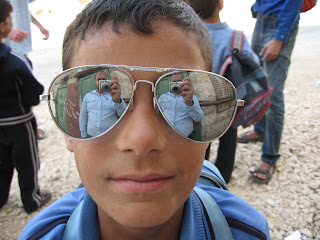
There has been a changing of the guards to all the new army guys are a little bit jittery. They're really harassing the Palestinians. Today I went down to checkpoint 56 just before sundown to check on the situation there. They have a habit of detaining people when its Iftar. Iftar is the first meal for Muslims to break their fast each night. So that being said, I stumbled upon checkpoint 56 to find they had detained a man. He had documentation that he has Angina which means he can't go through the metal detectors. Thankfully his family came and gave him a cigarette and some bread. I asked the soldiers what was going on and why this man was being detained. They claimed the only spoke Hebrew. Which is a crock of shit. I haven't run into a soldier yet who cant speak at least a little English.
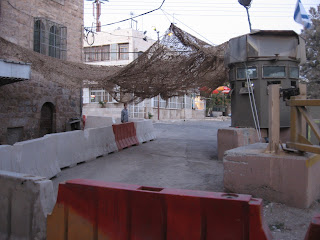
Some other soldiers came along and filled me in on the details. Apparently they had to wait for the commander to come along. Half hour later the commander comes along and within five minutes, it was sorted. Note to the Israeli Army recruiter: please consider raising the minimum IQ requirements to above 40. The crazy part about the check points in Tel Rumeida (the neighbourhood occupied by the settlers and protected by the army) is they're strictly there to harass.

There are checkpoints at all the points that Palestinians who live in Tel Rumeida have to go through in order to get home. The cab I got from the centre of town to the apartment, all I had to cross was a roadblock made of stones. So the security argument is complete BULLSHIT! It's strictly to make life as hard as possible for the Palestinians who choose to still live here. The area occupied by the Isralis is a ghost town. What was once a bustling market is now shadow of it's former self. Shop doors are welded shut with Stars of David spray painted on them.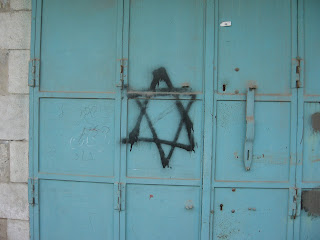
We also make a mosque run every other day. The mosque is the Ibrahimi Mosque. A very holy sight for both faiths therefore host to some of the worst secular tensions in the area. There was a shooting a few days ago. The army fired on some Palestinians claiming a kid came in there with a fake gun and fire cracker. Right. This place is also the scene of the 1994 massacre by Baruch Kappel Goldstein. Baruch went on a rampage on February 24th 1994 killing 29 and injuring 150. I think the settlers actually have a monument dedicated to this piece of filth.
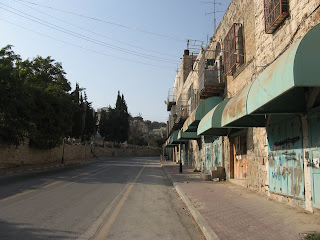
The other thing we do to occupy our time is guard Issa's house. The land this place is on is amazing. 1000 year old olive trees and roman walls surround the building. An amazing view of the old city which I'll try and post if I can ever get to a computer that isn't so slow it times out. The army and the settlers have both occupied this house. Issa won it back in court which is an absolutely huge victory. If we don't maintain a presence, there's a fear they'll burn it down. As it is, the worst we've had to put up with is some rock throwing in the back and some serious mosquitos.

Got word of a demonstration going on in Bilin on friday. Apparently it's really good out there because the protest groups are really well organized and come out in serious numbers. Not sure if I'm going to go out there or not. Some of the dudes here have been here for three weeks and are in serious need of a break. I might hold down the fort here and let them do their own thing. My only regret is I don't have as much time as I'd like.


There has been a changing of the guards to all the new army guys are a little bit jittery. They're really harassing the Palestinians. Today I went down to checkpoint 56 just before sundown to check on the situation there. They have a habit of detaining people when its Iftar. Iftar is the first meal for Muslims to break their fast each night. So that being said, I stumbled upon checkpoint 56 to find they had detained a man. He had documentation that he has Angina which means he can't go through the metal detectors. Thankfully his family came and gave him a cigarette and some bread. I asked the soldiers what was going on and why this man was being detained. They claimed the only spoke Hebrew. Which is a crock of shit. I haven't run into a soldier yet who cant speak at least a little English.

Some other soldiers came along and filled me in on the details. Apparently they had to wait for the commander to come along. Half hour later the commander comes along and within five minutes, it was sorted. Note to the Israeli Army recruiter: please consider raising the minimum IQ requirements to above 40. The crazy part about the check points in Tel Rumeida (the neighbourhood occupied by the settlers and protected by the army) is they're strictly there to harass.

There are checkpoints at all the points that Palestinians who live in Tel Rumeida have to go through in order to get home. The cab I got from the centre of town to the apartment, all I had to cross was a roadblock made of stones. So the security argument is complete BULLSHIT! It's strictly to make life as hard as possible for the Palestinians who choose to still live here. The area occupied by the Isralis is a ghost town. What was once a bustling market is now shadow of it's former self. Shop doors are welded shut with Stars of David spray painted on them.

We also make a mosque run every other day. The mosque is the Ibrahimi Mosque. A very holy sight for both faiths therefore host to some of the worst secular tensions in the area. There was a shooting a few days ago. The army fired on some Palestinians claiming a kid came in there with a fake gun and fire cracker. Right. This place is also the scene of the 1994 massacre by Baruch Kappel Goldstein. Baruch went on a rampage on February 24th 1994 killing 29 and injuring 150. I think the settlers actually have a monument dedicated to this piece of filth.

The other thing we do to occupy our time is guard Issa's house. The land this place is on is amazing. 1000 year old olive trees and roman walls surround the building. An amazing view of the old city which I'll try and post if I can ever get to a computer that isn't so slow it times out. The army and the settlers have both occupied this house. Issa won it back in court which is an absolutely huge victory. If we don't maintain a presence, there's a fear they'll burn it down. As it is, the worst we've had to put up with is some rock throwing in the back and some serious mosquitos.

Got word of a demonstration going on in Bilin on friday. Apparently it's really good out there because the protest groups are really well organized and come out in serious numbers. Not sure if I'm going to go out there or not. Some of the dudes here have been here for three weeks and are in serious need of a break. I might hold down the fort here and let them do their own thing. My only regret is I don't have as much time as I'd like.
Monday, October 8, 2007
Ladies and Gentlemen...Welcome to Hebron


So im now in Hebron, the second oldest city in the world. Second only to Jericho, another Palestinian city. The city is divided into two sections: H1 and H2. H1 is Palestinian controlled. H2 is under Israeli occupation. This is due to the unique fact that there is an illegal Israeli settlement in a built up urban area. The settlement houses about 500 of the most ideological and violent settlers. Their claim to the land is that there is the burial sight of Abraham as well as two people mentioned in the Torah. Theyre led by the most fascist right wing settler of them all: Baruh Marzel. He has his own wikipedia entry.
http://en.wikipedia.org/wiki/Baruch_Marzel

Took a three hour bus ride into the Hebron city centre. Then caught a cab to Tel Rumeida. Its really apparent that the whole goal of the Israelis is to annex all the fertile land and leave the Palestinians with nothing. You see one side of the highway with these amazing settlements and lush gardens and farmland. Then on the other you see dusty and decrepid Palestinian territory. Its the greatest injustice of our time.
ISM has an apartment in H2 right across from the settlement. Daily the settlers harass the Palestinian children as they come home from school. Throwing rocks as well as verbal harassment. There are other international watch dog groups here because its so bad. There are stars of David spray painted everywhere. Protecting the kids is one of our main jobs here. The other is protecting Issa's house. His house is on the other side of the settlement. Its been occupied by settlers as well as the IOF. Through court battles though, Issa managed to win it back. Must really cheese off the settlers, because they attempt to vanadalize it nightly so we have to send two ISMers out there each night to sleep in it.
The most surreal thing about muslim communities is the call to prayer from the mosques. The entire city fills with sound of the Quaran being sung from megaphones on the mosques. Must make the settlers shake in their boots. I love it.
Sunday, October 7, 2007
Finished Training
So today i finished my ISM training. I woke up, with no time to shower because I wanted to sleep as much as possible due to the fact that I went out for some pints with some friends last night until the wee hours of the morning. Quick face wash and it was on.
The training today consisted of six main sections: Culture, Security, Legal, Privelege, Self Care and Regional Updates. The areas ISM works in tend to be very conservative muslim areas. It can be very easy to offend even doing things that we think are fine. Women are to wear longsleeves and both sexes are to sleep in seperate areas. I think its in my best interest to walk around with longsleeves as well. Im finding it much easier to walk around when i keep my tattoos covered. Im less of a sideshow spectacle.
The security training consisted of some basic common sense things. Leaving contact numbers on your phone or having numbers written down can jeopordize the ISM operation if you try to cross a border with them. The legal delt with our rights as they relate to the main Israeli security juggernaut. We dont have to give our passport to the Army. We dont have give it to the police. If we get detained the army can hold us for three hours and the Police for 24. Generally if you are arrested, you wont get any charges against you. If its a violent offense they can deport you but it doesnt tend to go that way. More than likely, your friends can come get you with your passport (one of the techniques used is to have someone away from the front lines of the demonstration with the passports) and then your name gets recorded and you go home. Im still going to try my best not get arrested mind you.
Privelege, self care and regional updates, all went pretty fast. Privelege basically dealt with the fact that we internationals can leave so our actions can sometimes make things harder for palestinians in the end, even though we mean well. For example, if a checkpoint is moving extremely slowly or not at all and we start yelling at the guards to hurry up, they can end up closing the checkpoint for two hours and then the palestinians are even worse off. The one thing ISM maintains is that we are palestinian led. If the palestinians want our help then we are there. If not, we wait and observe.
After the regional updates i found out im going to be doing the bulk of my time in Hebron. Its an area in the south of the west bank that has some seriously ideological zionist settlers that are particularly nasty to the palestinians that live there. Its the second holiest sight in judaism. I think its where they think Abraham was burried. Their warped zionist mentality prompts them to believe that they can abuse the palestinians that live there. Ive heard one of the techniques they use is to get the settler children to throw rocks at them because they are unpunishable according to israeli civil law.
Im learning a few arabic phrases. Im hoping that my time in Hebron is somewhat chill so i can have time to brush up on my phrases. Im excited to meet the Palestinians from that area.
Some interesting facts about Palestinians. There are actually four types living in Palestine. The 1948 ones that have full Israeli citizenship, Israeli passports and all the amenities that go with it. They represent about 20% of the Israeli population. Then there are the East Jerusalem Palestinians. They have an Israeli ID card but arent allowed to have a passport or vote. Yet they live in Israel. Some democratic state they claim to be. There are then the West Bank/Gaza Palestinians. They have an ID card issued by the Palestinian Authourity. They can only come into Jerusalem via Qualendia checkpoint. They can be denied movement in their own country. They are forced to endure Main Checkpoints, Sub Main checkpoints and rolling checkpoints. The latter only really being there to hassle them, although its claimed its to try and track down wanted fighters from the armed Palestinian Resistance. I ask you this though: WHY THE FUCK WOULD A FIGHTER GO THROUGH A CHECKPOINT HE CAN SEE A MILE AWAY AND JUST GO AROUND? he wouldnt. its just put there as a collective punishment for the average person in the west bank. The last kind has no ID whatsoever. there are 12,000 of them. 8000 in gaza and 4000 in the west bank. They have absolutely NO ability to move within their own country. Unreal.
Heres a video of the settlers in Hebron:
The training today consisted of six main sections: Culture, Security, Legal, Privelege, Self Care and Regional Updates. The areas ISM works in tend to be very conservative muslim areas. It can be very easy to offend even doing things that we think are fine. Women are to wear longsleeves and both sexes are to sleep in seperate areas. I think its in my best interest to walk around with longsleeves as well. Im finding it much easier to walk around when i keep my tattoos covered. Im less of a sideshow spectacle.
The security training consisted of some basic common sense things. Leaving contact numbers on your phone or having numbers written down can jeopordize the ISM operation if you try to cross a border with them. The legal delt with our rights as they relate to the main Israeli security juggernaut. We dont have to give our passport to the Army. We dont have give it to the police. If we get detained the army can hold us for three hours and the Police for 24. Generally if you are arrested, you wont get any charges against you. If its a violent offense they can deport you but it doesnt tend to go that way. More than likely, your friends can come get you with your passport (one of the techniques used is to have someone away from the front lines of the demonstration with the passports) and then your name gets recorded and you go home. Im still going to try my best not get arrested mind you.
Privelege, self care and regional updates, all went pretty fast. Privelege basically dealt with the fact that we internationals can leave so our actions can sometimes make things harder for palestinians in the end, even though we mean well. For example, if a checkpoint is moving extremely slowly or not at all and we start yelling at the guards to hurry up, they can end up closing the checkpoint for two hours and then the palestinians are even worse off. The one thing ISM maintains is that we are palestinian led. If the palestinians want our help then we are there. If not, we wait and observe.
After the regional updates i found out im going to be doing the bulk of my time in Hebron. Its an area in the south of the west bank that has some seriously ideological zionist settlers that are particularly nasty to the palestinians that live there. Its the second holiest sight in judaism. I think its where they think Abraham was burried. Their warped zionist mentality prompts them to believe that they can abuse the palestinians that live there. Ive heard one of the techniques they use is to get the settler children to throw rocks at them because they are unpunishable according to israeli civil law.
Im learning a few arabic phrases. Im hoping that my time in Hebron is somewhat chill so i can have time to brush up on my phrases. Im excited to meet the Palestinians from that area.
Some interesting facts about Palestinians. There are actually four types living in Palestine. The 1948 ones that have full Israeli citizenship, Israeli passports and all the amenities that go with it. They represent about 20% of the Israeli population. Then there are the East Jerusalem Palestinians. They have an Israeli ID card but arent allowed to have a passport or vote. Yet they live in Israel. Some democratic state they claim to be. There are then the West Bank/Gaza Palestinians. They have an ID card issued by the Palestinian Authourity. They can only come into Jerusalem via Qualendia checkpoint. They can be denied movement in their own country. They are forced to endure Main Checkpoints, Sub Main checkpoints and rolling checkpoints. The latter only really being there to hassle them, although its claimed its to try and track down wanted fighters from the armed Palestinian Resistance. I ask you this though: WHY THE FUCK WOULD A FIGHTER GO THROUGH A CHECKPOINT HE CAN SEE A MILE AWAY AND JUST GO AROUND? he wouldnt. its just put there as a collective punishment for the average person in the west bank. The last kind has no ID whatsoever. there are 12,000 of them. 8000 in gaza and 4000 in the west bank. They have absolutely NO ability to move within their own country. Unreal.
Heres a video of the settlers in Hebron:
Subscribe to:
Posts (Atom)
