Saturday, April 12, 2008

Red Violin Steakhouse


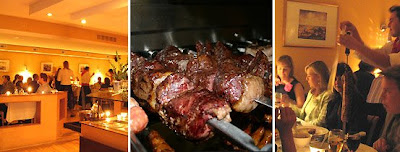
So the other night, my family and I made the trek to Broadview and Danforth to sample some of Toronto's only Brazillian Churasqueria Rodizio. This loosely translates to All You Can Eat Steakhouse. This shit was phenomenal.

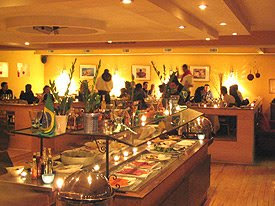
It all starts with an antipasto buffet filled to the nines with all sorts of marinated vegetables and peppers. Olives, prosciutto, shrimp and fine cheeses round out this solid buffet. Pretty good on it's own but it's simply a warm up for whats to come.

Once you've finished your warm up, you're given a card that is green on one side and red on the other. Pretty self explanatory. Green = Go. Red = Stop. BRING ON THE BBQ.

Our dinner started with some chicken wings and chicken drums. At the same time the bbq started, they also brought out the side dishes: homefries, carrots, mushrooms, black beans and rice. Pretty useless if you ask me. Couldn't tell you how the stuff tasted because I never even touched it.

The next thing to come out of the Churasco bbq was some delicious sausage. Followed shortly by some bacon wrapped filet and beef ribs. Mexican style parmesan beef and pork ribs were next. Then came the king of kings. The sirloin. It had this seasoning on it that was just salty enough to keep you craving more.

I kept it on green as long as I could. I like to think I would have made any carnivore proud. Once I flipped my card over to red it was time for dessert.

I don't know how they did it, but they made a pineapple taste even better. Rolled in cinnamon and sugar and then bbq'd for 15 minutes so the sugar can circulate throughout the whole fruit. Man o man.

The cost is pretty reasonable all things considered. If you're going to do a night at a steakhouse you could easily spend well over the 50 bucks a head. If you havent checked this place out DO IT!.

Red Violin Brazilian Steakhouse
95 Danforth Avenue
Toronto, ON M4K 1N2
416/465-0969

Friday, April 11, 2008

Communist Manifestoon


Displaying a broad range of Golden Age Hollywood animation, Manifestoon is a homage to the latent subversiveness of cartoons. Though U.S. cartoons are usually thought of as conveyors of capitalist ideologies of consumerism and individualism, Drew observes: “Somehow as an avid childhood fan of cartoons, these ideas were secondary to a more important lesson—that of the ‘trickster’ nature of many characters as they mocked, outwitted and defeated their more powerful adversaries. In the classic cartoon, brute strength and heavy artillery are no match for wit and humor, and justice always prevails. For me, it was natural to link my own childhood concept of subversion with an established, more articulate version [Marx and Engels’ Communist Manifesto]. Mickey running over the globe has new meaning in today’s mediascape, in which Disney controls one of the largest concentrations of media ownership in the world.”

We are in the worst financial crisis since Depression, says IMF


Governments will have to pay for more bailouts, says Fund as it slashes growth forecasts and warns of global recession.

Heather Stewart

The Guardian

The US mortgage crisis has spiralled into “the largest financial shock since the Great Depression” and there is a one-in-four chance that it will cause a full-blown global recession, the International Monetary Fund warned yesterday.

As finance ministers and central bankers arrived in Washington to discuss ways of tackling the crisis, the IMF warned, in its twice-yearly World Economic Outlook, that governments might be forced to step in with more public bailouts of troubled banks and cash-strapped homeowners before the crisis was over.

“The financial market crisis that erupted in August 2007 has developed into the largest financial shock since the Great Depression, inflicting heavy damage on markets and institutions at the core of the financial system,” it said.

After warning this week that the world’s financial firms could end up shouldering $1trn (£500bn) of losses from the credit crunch, the IMF said it expected the US to experience a “mild recession”, notching up GDP growth of 0.5% in 2008 and 0.6% in 2009. It expects house prices to fall by up to a further 10% before the downturn is over.

With the US sliding into such a recession, there is mounting pessimism about the ability of the rest of the world to escape unscathed. The IMF shaved its forecast for growth in the global economy by half a percentage point, to 3.7% for this year, and by 0.6% – to 3.8% – for 2009.

Although the Washington-based body expects most emerging economies to continue to grow strongly over the next two years, it admits that efforts to tackle the knock-on effects of the credit crunch could be hampered by fast-growing commodity prices. “Inflation has picked up around the globe, mainly reflecting sharp increases in food and energy prices,” it said.

In the US, President Bush has already signed off a $150bn tax rebate package to kick-start the US economy, and the Federal Reserve last month backed an extraordinary emergency buyout of the investment bank Bear Stearns.

However, the IMF said more taxpayers’ cash may still need to be spent to unblock the markets. “Given the serious risks coming from sustained financial market dislocations, the recent legislation to provide additional fiscal support for an economy under stress is fully justified, and room may need to be found for some additional support for housing and financial markets.”

Simon Johnson, IMF research director, presenting the report in Washington, described such bailouts as an essential “third line of defence”, after interest rate and tax cuts, for governments struggling to prevent a deep recession.

He said the main risk to the global economy over the next year was the emergence of a vicious circle, as house prices continued to fall, dealing a fresh blow to the world’s banks, and creating a damaging feedback loop.

“Sentiment in financial markets has improved in recent weeks since the Federal Reserve’s strong actions with regard to investment banks. But we have seen how strains in markets can quickly become reinforcing, and the possibility of a negative spiral or ‘financial decelerator’ remains a possibility,” he warned.

The IMF’s downbeat analysis creates a gloomy backdrop for policymakers arriving in Washington to discuss ways of easing the credit squeeze. Such is the concern about problems in the financial markets that a range of radical options is on the table. These include greater disclosure of losses on sub-prime assets by banks; firmer regulation of credit-rating agencies, and – more controversially – plans for taking some of the risky mortgage-backed assets at the heart of the crisis on to government balance sheets. Alistair Darling, the chancellor, is calling for a detailed plan to be agreed over the weekend.

The IMF backed more comprehensive disclosure by banks. “We fully support the move towards greater disclosure,” Johnson said. “We think that marking to market [rating assets on current market values, not book values] and continuing to recognise losses is an important part of how the financial system operates.”

The US Federal Reserve has cut US interest rates by a hefty 3 percentage points to 2.25% since the crisis began, in an attempt to restore confidence and turn the credit taps back on. The IMF welcomed the Fed’s approach but said it would not be enough to prevent recession.

“Adverse financial conditions are likely to have a continuing negative impact on activity in the United States, notwithstanding the Federal Reserve’s strong response,” it said. “The United States remains plagued by profound errors in risk management.”

The value of the dollar has plunged to record lows in the past year as the outlook for the US economy has darkened, but the IMF said the greenback still “remains somewhat on the strong side”.
No bounce after the hard landing

Alistair Darling’s forecast that Britain will bounce back from the credit crunch by next year now looks hopelessly optimistic, according to an authoritative assessment by the International Monetary Fund.

Just a month ago, in the budget, the Treasury had pencilled in 2% GDP growth this year and 2.5% in 2009 as the economy recovers, but yesterday the Washington-based IMF predicted far weaker growth of 1.6% both years.

The chancellor has said repeatedly that Britain is “better placed” to weather the storm because of its low unemployment and flexible labour market, but the IMF calculates that the housing market is overvalued by up to 30% and faces a damaging correction.

“The housing market is going to be a drag on the economy,” said Charles Collyns, a senior IMF economist. “We do see house prices softening already, and we see potential that the housing correction will continue, with an impact on consumption. We also see the UK being affected by the tightening of the financial constraints related to the turmoil in the financial markets.”

He added that the knock-on effects of weak growth in the US and the eurozone would also depress growth.

House prices fell 2.5% last month, Halifax said, and the IMF says the wider economy will be hit hard as overstretched banks repair balance sheets and borrowers face tighter loan conditions and higher interest rates. In January, when it last updated forecasts, the IMF was expecting expansion of 2.4% in 2009, but the longer the credit crunch continues, the more threatened the UK economy has become. Darling said yesterday that the downgrade was “not surprising” and the economy was “extremely strong”.

This article originally appeared in The Guardian.

Sunday, April 6, 2008

Rachel Corrie Remembered

The Ethic of Knowledgeand the Socialist Ideal


Jacques Monod (1970)
concluding paragraphs from Chance & Necessity
Source: Chance and Necessity publ. Collins, 1970
the need for an explanation
For hundreds of thousands of years a man's lot was identical with that of the group, of the tribe he belonged to, and outside which he could not survive. The tribe, for its part, could only survive and defend itself through its cohesion. Whence arose the extreme subjective power of the laws that organised and guaranteed this cohesion. A man might perhaps infringe them; it is unlikely that anyone ever dreamed of denying them. Given the immense selective importance such social structures perforce assumed over such vast stretches of time, it is difficult not to believe that they must have influenced the genetic evolution of the innate categories of the human brain. This evolution must not only have facilitated acceptance of the tribal law, but created the need for the mythical explanation which gave it a foundation and sovereignty. We are the descendants of these men, and it is probably from them that we have inherited the need for an explanation, the profound disquiet which forces us to search for the meaning of existence. That same disquiet has created all myths, all religions, all philosophies and science itself.
I have very little doubt that this imperious need develops spontaneously, that it is inborn, inscribed somewhere in the genetic code. Apart from the human species, nowhere in the animal kingdom does one find such highly differentiated social organisations except among certain insects: ants, termites, bees. The stability of the social insects' institutions owes next to nothing to cultural heritage, but virtually everything to genetic transmission. Social behaviour, with them, is entirely innate, automatic.
Man's social institutions, which are purely cultural, cannot ever attain such stability; anyway, who would wish for it? The invention of myths and religions, the construction of vast philosophical systems - they are the price man has had to pay in order to survive as a social animal without yielding to pure automatism. But a cultural heritage would not, all alone, have been strong or reliable enough to hold up the social structure. That heritage needed a genetic support to provide something essential to the mind. How else account for the fact that in our species the religious phenomenon is invariably at the base of social structure? How else explain that, throughout the immense variety of our myths, our religions and philosophical ideologies, the same essential 'form' always recurs?
mythic and metaphysical ontogenies
It is easy to see that the 'explanations', which gave a foundation to the law while assuaging man's anxiety, are all 'stories' or, more exactly, 'ontogenies'. Primitive myths almost all tell of more or less divine heroes whose deeds explain the origins of the group and base its social structure upon sacrosanct traditions; one does not remake history. The great religions are of a similar form, based on the story of the life of an inspired prophet who, if not himself the founder of all things, represents that founder, speaks for him, and recounts the history of mankind as well as its destiny. Of all the great religions Judeo-Christianity is probably the most 'primitive' in its strictly historicist structure, being founded on the saga of a Bedouin tribe before being enriched by a divine prophet. Buddhism, which is more highly differentiated, is based in its original form on Karma, the transcending law governing individual destiny. Buddhism is a story of souls rather than of men.
From Plato to Hegel and Marx, the great philosophical systems all propose ontogenies which are both explanatory and normative. It is true that, in Plato's case, the course is downhill rather than ascending. He sees in history only the gradual corruption of ideal forms, and his aim in the Republic is to reinstate the past, to move backwards in time.
For Marx, as for Hegel, history unfolds according to an immanent, necessary, and favourable plan. The immense influence of Marxist ideology is not due only to its promise of man's liberation, but also, and probably mainly, to its ontogenetic structure, the explanation which it provides, both sweeping and detailed, of past, present, and future history. However, limited to human history, even though decked with the certainties of 'science', historical materialism was still incomplete. It needed the addition of dialectical materialism which provides the total interpretation the mind needs: in this, the history of mankind is bound up with that of the cosmos, obeying the same eternal laws.
the breakdown of the old covenant and the modern soul's distress
If there is an innate need for a complete explanation whose absence causes a deep inner anxiety; if the only form of explanation which can ease the soul is that of a total history which reveals the significance of man by assigning him a necessary place in nature's scheme; if, to appear genuine, meaningful, soothing, the 'explanation' must be fused with the long animist tradition, then we understand why so many thousand years passed before the appearance, in the realm of ideas, of those presenting objective knowledge as the only source real truth.
Cold and austere, proposing no explanation but imposing an ascetic renunciation of all other spiritual fare, this idea could not allay anxiety; it aggravated it instead. It claimed to sweep away at a stroke the tradition of a hundred thousand years, which had become assimilated in human nature itself. It ended the ancient animist covenant between man and nature, leaving nothing in place of that precious bond but an anxious quest in a world of icy solitude. With nothing to recommend it but a certain puritan arrogance, how could such an idea be accepted? It was not; it still is not. if it has commanded recognition, this is solely because of its prodigious powers of performance.
In the course of three centuries, science, founded upon the postulate of objectivity, has won its place in society - in men's practice, but not in their hearts. Modern societies are built upon science. To it they owe their wealth, their power, and the certitude that tomorrow even greater wealth and power will be ours if we so wish. But there is this too: just as an initial 'choice' in the biological evolution of a species can be binding upon its entire future, so the choice of scientific practice (an unconscious choice in the beginning) has launched the evolution of culture on a one-way path; on to a track which nineteenth-century scientism saw leading infallibly on to a vast blossoming for mankind, whereas what we see before us today is an abyss of darkness.
Modern societies accepted the treasures and the power offered them by science. But they have not accepted - they have scarcely even heard - its profounder message: the defining of a new and unique source of truth, and the demand for a thorough revision of ethical premises, for a complete break with the animist tradition, the definitive abandonment of the 'old covenant', the necessity of forging a new one. Armed with all the powers, enjoying all the riches they owe to science, our societies are still trying to live by and to teach systems of values already blasted at the root by science itself.
No society before ours was ever torn apart by such conflicts. In both primitive and classical cultures the animist tradition saw knowledge and values stemming from the same source. For the first time in history a civilisation is trying to shape itself while clinging desperately to the animist tradition in an effort to justify its values, and at the same time abandoning it as the source of knowledge, of truth. The 'liberal' societies of the West still pay lip-service to, and present as a basis for morality, a disgusting farrago of Judeo-Christian religiosity, scientistic progressism, belief in the 'natural' rights of man, and utilitarian pragmatism. The Marxist societies still profess the materialist and dialectical religion of history; on the face of it a more solid moral framework than that of the liberal societies, but perhaps more vulnerable by virtue of the very rigidity which up to now has been its strength. However this may be, all these systems rooted in animism exist outside objective knowledge, outside truth, and are strangers and fundamentally hostile to science, which they are willing to use but do not respect or cherish. The divorce is so great, the lie so flagrant, that it can only obsess and lacerate anyone who has some culture or intelligence, or is moved by that moral questioning which is the source of all creativity. It is an affliction, that is to say, for all those who bear or will bear the responsibility for the way in which society and culture will evolve.
The sickness of the modern spirit is this, and lie at the root of man's moral and social nature. It is this ailment, more or less confusedly diagnosed, that provokes the fear if not the hatred - in any case the estrangement - felt toward scientific culture by so many people today. Their aversion, when openly expressed, is usually directed at the technological by-products of science: the bomb, the destruction of nature, the soaring population. It is easy, of course, to answer that technology and science are not the same thing, and moreover that the use of atomic energy will soon be vital to mankind's survival; that the destruction of nature denotes a faulty technology rather than too much of it; and that the population soars because millions of children are saved from death every year. Are we to go back to letting them die?
This is a superficial reply, confusing the symptoms of the disorder with its underlying cause. For behind the protest is the refusal to accept the essential message of science. The fear is the fear of sacrilege: of outrage to values; and it is wholly justified. It is perfectly true that science attacks values. Not directly, since science is no judge of them and must ignore them; but it subverts every one of the mythical or philosophical, ontogenies upon which the animist tradition, from the Australian aborigines to the dialectical materialists, has based morality: values, duties, rights, prohibitions.
If he accepts this message in its full significance, man must at last wake out of his millenary dream and discover his total solitude, his fundamental isolation. He must realise that, like a gypsy, he lives on the boundary of an alien world; a world that is deaf to his music, and as indifferent to his hopes as it is to his suffering or his crimes.
Who, then, is to define crime? Who decides what is good and what is evil? All the traditional systems placed ethics and values beyond man's reach. Values did not belong to him; they were imposed on him, and he belonged to them. Today he knows that they are his and his alone, but now he is master of them they seem to be dissolving in the uncaring emptiness of the universe. It is at this point that modern man turns toward science, or rather against it, now seeing its terrible capacity to destroy not only bodies but the soul itself.
values and knowledge
Where is the remedy? Must one claim once and for all that objective truth and the theory of values are eternally opposed, mutually impenetrable domains? This is the attitude adopted by many modern thinkers, whether writers, or philosophers, or indeed scientists. I believe that it is not only unacceptable to the vast number of men, whose anxiety it can only perpetuate and worsen; I also, believe it is absolutely mistaken, for two essential reasons.
First, of course, because values and knowledge are always and necessarily associated in action as in discourse.
Second, and above all, because the very definition of 'true' knowledge rests in the final analysis upon an ethical postulate.
Each of these two points needs to be briefly developed.
Ethics and knowledge are inevitably linked in and through action. Action brings knowledge and values simultaneously into play, or into question. All action signifies an ethic, serves or disserves certain values; constitutes a choice of values, or pretends to. On the other hand, knowledge is necessarily implied in all action, while reciprocally, action is one of the two necessary sources of knowledge.
In an animist system the interpenetration of ethics and knowledge creates no conflict, since animism avoids any basic distinction between these two categories: it sees them as two aspects of the same reality. The idea of a social ethic founded upon the so-called 'natural' rights of man also reflects this outlook, displayed, but much more systematically and emphatically, in the attempts to delineate the ethics implicit in Marxism.
From the moment objectivity is made the conditio sine qua non of true knowledge, a radical distinction, indispensable to the very search for truth, is established between the domains of ethics and of knowledge. Knowledge in itself is exclusive of all value judgment (except that of 'epistemological value') whereas ethics, in essence non-objective, is for ever barred from the sphere of knowledge.
It is in effect this radical distinction, laid down as an axiom, that created science. I am tempted to suggest that if this unprecedented event in the history of culture occurred in the Christian West rather than in some other civilisation, it was perhaps partly thanks to the fundamental distinction drawn by the Church between the domains of the sacred and the profane. Not only did this distinction allow science to pursue its own way (provided it did not trespass on the realm of the sacred); it prepared the mind for the much more radical distinction posed by the principle of objectivity. Westerners often have trouble in understanding that for certain religions there is not and cannot be any distinguishing between sacred and profane: for Hinduism, everything comes within the bounds of the sacred; the very concept of 'profane' is incomprehensible.
But let us return to our main point. The postulate of objectivity, denouncing the 'old covenant', at the same time forbids any confusion of value judgments with judgments arrived at through knowledge. Yet the fact remains that these two categories inevitably unite in the form of action, discourse included. To abide by our principle we shall therefore take the position that no discourse or action is to be considered meaningful, authentic, unless - or only insofar as - it makes explicit and preserves the distinction between the two categories it combines. Thus defined, the concept of authenticity becomes the common round where ethics and knowledge meet again; where values and truth, associated but not interchangeable, reveal their full significance to the attentive man alive to their resonance. In return, inauthentic discourse, where the two categories are jumbled, can lead only to the most pernicious nonsense, to the most criminal, even if unconscious, lies.
It is in 'political' discourse (and I mean 'discourse' in the Cartesian sense), of course, that this hazardous amalgamation is most consistently and systematically practised. And not by professional politicians alone. Scientists themselves, outside their field, often prove dangerously incapable of distinguishing between the categories of values and of knowledge.
Animism, we said earlier, neither wants nor for that matter is able to set up an absolute discrimination between value judgments and statements based upon knowledge; for having once assumed that there is an intention, however carefully disguised, present in the universe, what would be the sense of such a distinction? In an objective system the very opposite holds: any confusion of knowledge with values is unlawful, forbidden. But - and this is the crucial point - the logical link which radically binds knowledge and values - this ban, this 'first commandment' which ensures the foundation of objective knowledge, itself is not, and cannot be, objective. It is a moral rule, a discipline. True knowledge is ignorant of values, but it has to be grounded on a value judgment, or rather on an axiomatic value. It is obvious that the positing of the principle of objectivity as the condition of true knowledge constitutes an ethical choice and not a judgment reached from knowledge, since, according to the postulate's own terms, there cannot have been any 'true' knowledge prior to this arbitral choice. In order to establish the norm for knowledge the objectivity principle defines a value: that value is objective knowledge itself. To assent to the principle of objectivity is, thus, to state the basic proposition of an ethical system: the ethic of knowledge.
the ethic of knowledge
In the ethic of knowledge it is the ethical choice of a primary value that is the foundation. The ethic of knowledge thereby differs radically from animist ethics, which all claim to be based on the 'knowledge' of immanent, religious or 'natural' laws which are supposed to impose themselves on man. The ethic of knowledge does not impose itself on man; on the contrary, it is he who imposes it on himself, making it the axiomatic condition of authenticity for all discourse and all action. The Discourse on Method proposes a normative epistemology, but it must also be read above all as a moral meditation, a spiritual exercise.
Authentic discourse is in its turn the foundation of science, and it gives back to man the immense powers that enrich and threaten him today, that free him but might also subjugate him. Modern societies, woven together by science, living from its products, have become as dependent upon it as an addict on his drug. They owe their material power to this fundamental ethic upon which knowledge is based, and their moral weakness to those value-systems devastated by knowledge itself, to which they still try to refer. The contradiction is deadly. This is what is digging the pit we see opening under our feet. The ethic of knowledge that created the modern world is the only ethic compatible with it, the only one capable, once understood and accepted, of guiding its evolution.
Understood and accepted - could it be? If it is true, as I believe, that the fear of solitude and the need for a complete and binding explanation are inborn - that this heritage from the remote past is not only culturally but probably genetic too - can one imagine such an austere, abstract, proud ethic calming that fear, satisfying that need? I do not know. But it may not be altogether impossible. Perhaps, even more than an 'explanation' which the ethic of knowledge cannot supply, man needs to rise above himself, to find transcendence. The abiding power of the great socialist dream, still alive in men's hearts, would indeed seem to suggest it. No system of values can claim to constitute a true ethic unless it proposes an ideal transcending the individual self to the point even of justifying self-sacrifice, if need be.
By the very loftiness of its ambition the ethic of knowledge might perhaps satisfy this craving for something higher. It puts forward a transcendent value, true knowledge, not for the use of man, but for man to serve from deliberate and conscious choice. At the same time it is also a humanist ethic, for it respects man as the creator and repository of that transcendence.
The ethic of knowledge is also in a sense 'knowledge of ethics', that is, of the urges and passions, the needs and limitations of the biological being. It is able to confront the animal in man, to see him not as absurd but strange, precious in his very strangeness: the creature who, belonging simultaneously to the animal kingdom and the kingdom of ideas, is both torn and enriched by this agonising duality, expressed alike in art and poetry and in human love.
Conversely, the animist systems have to one degree or another preferred to ignore, denigrate or bully biological man, and to make him fear or abhor certain traits inherent in his animal nature. The ethic of knowledge, on the other hand, encourages him to honour and assume this heritage, while knowing how to dominate it when necessary. As for the highest human qualities, courage, altruism, generosity, creative ambition, the ethic of knowledge both recognises their socio-biological origin and affirms their transcendent value in the service of the ideal it defines.
the ethic of knowledge and the socialist ideal
Finally, the ethic of knowledge is, in my view, the only attitude which is both rational and resolutely idealistic, and on which a real socialism might be built. For the young in spirit that great vision of the nineteenth century still persists with grievous intensity. Grievous because of the betrayals this ideal has suffered, and because of the crimes committed in its name. it is tragic, but was perhaps inevitable, that this profound aspiration had to find its philosophical doctrine in the form of an animist ideology. Looking back, it is easy to see that, from the time of its birth, historical messianism based on dialectical materialism contained the seeds of all the dangers later encountered. Perhaps more than the other animisms, historical materialism is based on a total confusion of the categories of value and knowledge. This very confusion permits it, in a travesty of authentic discourse, to proclaim that it has 'scientifically' established the laws of history, which man has no choice or duty but to obey if he does not wish to sink into oblivion.
This illusion, which is merely puerile when it is not fatal, must be given up once and for all. How can an authentic socialism ever be built on an essentially inauthentic ideology, a caricature of that very science whose support it claims (most sincerely, in the minds of its followers)? Socialism's one hope is not in a 'revision' of the ideology that has been dominating it for over a century, but in completely abandoning that ideology.
Where then shall we find the source of truth and the moral inspiration for a really scientific socialist humanism? Only, we suggest, in the sources of science itself, in the ethic upon which knowledge is founded, and which by free choice makes knowledge the supreme value - the measure and guarantee for all other values. An ethic which bases moral responsibility upon the very freedom of that axiomatic choice. Accepted as the foundation for social and political institutions, and as the measure of their authenticity and their value, only the ethic of knowledge could lead to socialism. It prescribes institutions dedicated to the defence, the extension, the enrichment of the transcendent kingdom of ideas, of knowledge, and of creation - a kingdom which is within man, where progressively freed both from material constraints and from the misleading servitudes of animism, man could at last live authentically; there he would be protected by institutions which, seeing him as both the subject of the kingdom and its creator, would serve him in his unique and precious essence.
This is perhaps a utopia. But it is not an incoherent dream. It is an idea that owes its strength to its logical coherence alone. It is the conclusion to which the search for authenticity necessarily leads. The ancient covenant is in pieces; man at last knows that he is alone in the unfeeling immensity of the universe, out of which he emerged only by chance. Neither his destiny nor his duty have been written down. The kingdom above or the darkness below: it is for him to choose.

Saturday, April 5, 2008

Urban Sprawl


Urban sprawl
From Wikipedia, the free encyclopedia

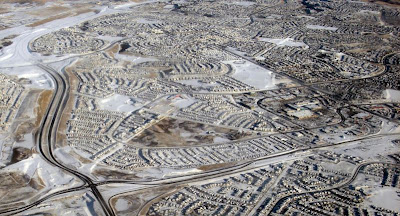
Urban sprawl, also known as suburban sprawl, is the spreading of a city and its suburbs over rural land at the fringe of an urban area.[1] Residents of sprawling neighborhoods tend to live in single-family homes and commute by automobile to work. Low population density is an indicator of sprawl. Urban planners emphasize the qualitative aspects of sprawl such as the lack of transportation options and pedestrian friendly neighborhoods. Conservationists tend to focus on the actual amount of land that has been urbanized by sprawl.[1]
The term urban sprawl generally has negative connotations due to the health and environmental issues that sprawl creates.[2] Residents of sprawling neighborhoods tend to emit more pollution per person and suffer more traffic fatalities.[3][4] Sprawl is controversial, with supporters claiming that consumers prefer lower density neighborhoods and that sprawl does not necessarily increase traffic.[5] Sprawl is also linked with increased obesity since walking and bicycling are not viable commuting options.[6] Sprawl negatively impacts land and water quantity and quality and may be linked to a decline in social capital.[4]


Characteristics
Sprawl is characterized by several land use patterns which usually occur in unison:

Single-use zoning
This refers to a situation where commercial, residential, and industrial areas are separated from one another. Consequently, large tracts of land are devoted a single use and are segregated from one another by open space, infrastructure, or other barriers. As a result, the places where people live, work, shop, and recreate are far from one another, usually to the extent that walking is not practical, so all these activities generally require an automobile (though a bicycle may also be feasible).[2]

Low-density land use
Sprawl consumes much more land than traditional urban developments because new developments are of low density. The exact definition of "low density" is arguable, but a common example is that of single family homes, as opposed to apartments. Buildings usually have fewer stories and are spaced farther apart, separated by lawns, landscaping, roads or parking lots. Lot sizes are larger, and because more automobiles are used much more land is designated for parking. The impact of low density development in many communities is that developed or "urbanized" land is increasing at a faster rate than the population.
Another kind of low-density development is sometimes called leap-frog development. This term refers to the relationship, or lack thereof, between one subdivision and the next. Such developments are typically separated by large green belts, ie tracts of undeveloped land, resulting in an average density far lower even than the low density described in the previous paragraph. This is a 20th and 21st century phenomenon generated by the current custom of requiring a developer to provide subdivision infrastructure as a condition of development (DeGrove and Turner, 1991).[7] Usually, the developer is required to set aside a certain percentage of the developed land for public use, including roads, parks and schools. In the past, when a local government built all the streets in a given location, the town could expand without interruption and with a coherent circulation system, because it had condemnation power. Private developers generally do not have such power (although they can sometimes find local governments willing to help), and often choose to develop on the tracts that happen to be for sale at the time they want to build, rather than pay extra or wait for a more appropriate location.

Car-dependent communities
Areas of urban sprawl are also characterized as highly dependent on automobiles for transportation, a condition known as automobile dependency. Most activities, such as shopping, commuting to work, concerts, etc. require the use of a car as a result of both the area's isolation from the city and the isolation the area's residential zones have from its industrial and commercial zones. Walking and other methods of transit are not practical; therefore, many of these areas have few or no sidewalks. In many suburban communities, even stores and activities that are close by are contrived to be much further, by separating uses with fences, walls, and drainage ditches.

Developments characteristic of sprawl

Housing subdivisions
Housing subdivisions are large tracts of land consisting entirely of newly-built residences. Duany and Plater-Zyberk claim that housing subdivisions “are sometimes called villages, towns, and neighborhoods by their developers, which is misleading since those terms denote places which are not exclusively residential.[8]
Subdivisions often incorporate curved roads and culs-de-sac. Such subdivisions may offer only a few places to enter and exit the development, causing traffic to use high volume collector streets. All trips, no matter how short, must enter the collector road in a suburban system. (Duany Plater-Zyberk 5, 34)

Strip malls
Shopping centers are locations consisting of retail space. In the U.S. and Canada, suburban context these vary from strip malls which refer to collections of buildings sharing a common parking lot, usually built on a high-capacity roadway with commercial functions (i.e., a "strip"). Similar developments in the UK are called Retail Parks. Strip malls/retail parks contain a wide variety of retail and non-retail functions that also cater to daily use (e.g. video rental, takeout food, laundry services, hairdresser). Strip malls consisting mostly of big box stores or category killers are sometimes called "power centers" (USA). These developments tend to be low-density; the buildings are single-story and there is ample space for parking and access for delivery vehicles. This character is reflected in the spacious landscaping of the parking lots and walkways and clear signage of the retail establishments. Some strip malls are undergoing a transformation into Lifestyle centers; entailing investments in common areas and facilities (plazas, cafes) and shifting tenancy from daily goods to recreational shopping. European countries such as France, Belgium and Germany have implemented size restrictions for superstores found in strip malls in an effort to limit sprawl (Davies 1995).

Shopping malls
Another prominent form of retail development in areas characterized by "sprawl" is the shopping mall. Unlike the strip mall, this is usually comprised of a single building surrounded by a parking lot which contains multiple shops, usually "anchored" by one or more department stores (Gruen and Smith 1960). The function and size is also distinct from the strip mall. The focus is almost exclusively on recreational shopping rather than daily goods. Shopping malls also tend to serve a wider (regional) public and require higher-order infrastructure such as highway access and can have floorspaces in excess of a million square feet (ca. 100,000 m²). Until recently, the largest shopping mall in the world was the West Edmonton Mall, while the largest in the United States is the Mall of America. Now, several larger ones have been built and/or are planned in China. Shopping malls are often detrimental to downtown shopping centers of nearby cities since the shopping malls acts as a surrogate for the city center (Crawford 1992). Some downtowns have responded to this challenge by building shopping centers of their own (Frieden and Sagelyn 1989; consider also Toronto Eaton Centre (1977), Ottawa's Rideau Centre, Boston's Shops at Prudential Center, and Providence's Providence Place).
In the 1970s the Ontario Government created the Ontario Downtown Renewal Programme (ODRP), which helped finance the building of several downtown malls across Ontario. See entry under Eaton Centre. The program was created to reverse the tide of small business leaving downtowns for larger sites surrounding the city.

Fast food chains
Fast food chains are common in suburban areas. They are often built early in areas with low property values where the population is about to boom and where large traffic is predicted, and set a precedent for future development. Eric Schlosser, in his book Fast Food Nation, argues that fast food chains accelerate suburban sprawl and help set its tone with their expansive parking lots, flashy signs, and plastic architecture (65). Duany Plater Zyberk & Company believe that this only reinforces a destructive pattern of growth in an endless quest to move away from the sprawl that only results in creating more of it (Duany Plater-Zyberk 26).

Examples
In the United States, Atlanta, Georgia is an example of a large urban area with a low population density. Atlanta metropolitan area covers 16,078 km² with a population of 4,112,198 people for a density of 255.8/km².[9] This is approximately one-third the density of the New York urbanized area. The urban area of Melbourne, Australia in 2006 had 3,371,889 people over 2152.8 km²,[10] giving a population density of 1566.3/km². Helsinki Metropolitan Area in Finland has 1,232,595 people spread over 2,970.6 km² area, resulting in a population density of 415.0/km². The Kansas City Metropolitan Area has a population of 1,967,405 people spread over an area of 14,002 km², resulting in a density of just 140.5/km².
According to the National Resources Inventory (NRI), about 8,900 square kilometers (2.2 million acres) of land was developed between 1992 and 2002. Presently, the NRI classifies approximately 100,000 more square kilometers (40,000 square miles) (an area approximately the size of Kentucky) as developed than the Census Bureau classifies as urban. The difference in the NRI classification is that it includes rural development, which by definition cannot be considered to be "urban" sprawl. Currently, according to the 2000 Census, approximately 2.6 percent of the US land area is urban.[11]Approximately 0.8 percent of the nation's land is in the 37 urbanized areas with more than 1,000,000 population. In 2002, these 37 urbanized areas supported around 40% of the total American population.[12]

Nonetheless, some urban areas have expanded geographically even while losing population. But it was not just US urbanized areas that lost population and sprawled substantially. According to data in "Cities and Automobile Dependence" by Kenworthy and Laube (1999), urbanized area population losses occurred while there was an expansion of sprawl between 1970 and 1990 in Brussels, Belgium; Copenhagen, Denmark; Frankfurt, Germany; Hamburg, Germany; Munich, Germany and Zurich, Switzerland, albeit without the wholesale dismantling of public transit systems that occurred in the United States.
At the same time, the urban cores of these and nearly all other major cities in the United States, Western Europe and Japan[citation needed] that did not annex new territory experienced the related phenomena of falling household size and "white flight", sustaining population losses.[13] This trend has slowed somewhat in recent years, as more people have regained an interest in urban living.
The term "Los Angelization" is also sometimes used for urban sprawl, though this may be misleading. Los Angeles was one of the world's first low density urbanized areas, as a result of wide automobile ownership. However, Los Angeles has become more dense over the past half-century, principally due to small lot zoning and a high demand for housing due to population growth. Los Angeles increased its density to 2240/km² (5,801 per square mile) in 1990. Land consumption per resident in 1990 was 0.11 acre, which made Los Angeles the most densely populated urbanized area in America.[14]

Smart growth

The first urban growth boundary in the US was in Fayette County, Kentucky in 1958.[citation needed] Fifteen years later, the state of Oregon enacted a law in 1973 limiting the area urban areas could occupy, through urban growth boundaries. As a result, Portland, the state's largest urban area, has become a leader in smart growth policies that seek to make urban areas more compact (they are called urban consolidation policies). After the creation of this boundary, the population density of the urbanized area increased somewhat (from 1,135 in 1970 to 1,290 per km² in 2000) USA Urbanized Areas 1950-1990 USA Urbanized Areas 2000. While the growth boundary has not been tight enough to vastly increase density, the consensus is that the growth boundaries have protected great amounts of wild areas and farm land around the metro area.
Many parts of the San Francisco Bay Area have also adopted urban growth boundaries; 25 of its cities and 5 of its counties have urban growth boundaries. Many of these were adopted with the support and advocacy of Greenbelt Alliance, a non-profit land conservation and urban planning organization.
In other areas, the design principles of District Regionalism and New Urbanism have been employed to combat urban sprawl.

Criticism and response

Rural neighborhoods in Morrisville, North Carolina are rapidly developing...

...into affluent, urbanized neighborhoods and subdivisions. These two images are on opposite sides of the same street.

Criticism
Arguments opposing urban sprawl run the gamut from the more concrete effects such as health and environmental issues to more abstract consequences involving neighorhood vitality.

Health and environmental impact
Urban sprawl is associated with a number of negative environmental and public health outcomes. The primary cause of these negative outcomes is that sprawl leads to people having to depend on the automobile because it will be a greater distance to travel and people will not be able to walk or ride their bicycles to their destinations.
However, this is mitigated significantly with nearyby development of shopping and recreation areas. Also, many people prefer to live close to their place of business which is increasingly centered less around urban areas.[2]

Increased pollution and reliance on fossil fuel
In the years following World War II, when vehicle ownership was becoming widespread, public health officials recommended the health benefits of suburbs due to soot and industrial fumes in the city center. However, air in modern suburbs is not necessarily cleaner than air in urban neighborhoods. In fact, the most polluted air is on crowded highways, where people in suburbs tend to spend more time. On average, suburban residents generate more pollution and carbon emissions than their urban counterparts because of their increased driving.[2]

Increase in traffic and traffic-related fatalities
A heavy reliance on automobiles increases traffic throughout the city as well as automobile crashes, pedestrian injuries, and air pollution. Motor vehicle crashes are the leading cause of death for Americans between the ages of five and twenty-four and is the leading accident-related cause for all age groups.[15] Residents of more sprawling areas are at greater risk of dying in a car crash.[16]

Increased obesity
The American Journal of Public Health and the American Journal of Health Promotion, have both stated that there is a significant connection between sprawl, obesity, and hypertension.[6] Presumably, living in a car centered culture forces inhabitants to drive everywhere, thus walking far less than their urban (and generally more healthy) counterparts.

Decrease in social capital
Urban sprawl may be partly responsible for the decline in social capital in the United States. Compact neighborhoods can foster casual social interactions among neighbors, while low-density sprawl creates barriers to interaction. Sprawl tends to replace public spaces such as parks with private spaces such as fenced-in backyards. Residents of sprawling neighborhoods rarely walk for transportation, which reduces opportunities for face-to-face contact with neighbors.[4]

Decrease in land and water quantity and quality
Due to the larger area consumed by sprawling suburbs compared to urban neighborhoods, more farmland and wildlife habitats are displaced per resident. As forest cover is cleared and covered with concrete in the suburbs, rainfall is less effectively absorbed into the ground water aquifers.[2] This threatens both the quality and quantity of water supplies. Sprawl increases water pollution as rain water picks up gasoline and oil runoff from parking lots and roads. Sprawl fragments the land which increases the risk of invasive species spreading into the remaining forest.

Increased infrastructure costs
Living in a larger, more spread out space makes public services more expensive. Since car usage often becomes endemic and public transport often becomes significantly more expensive, city planners are forced to build large highway and parking infrastructure, which in turn decreases taxable land and revenue, and decreases the desirability of the area adjacent to such structures. Providing services such as water, sewers, and electricity is also more expensive per household in less dense areas. [2]

Increased personal transportation costs
Residents of low density areas spend a higher proportion of their income on transportation than residents of high density areas.[17] The RAC estimates that the average cost of operating a car in the UK is £5,000 a year.[18] In comparison, a yearly underground ticket for a suburban commuter in London (where wages are higher than the national average) costs £1,000-1,500.

In Utah, which has been one of the top ten fastest growing U.S. states since at least 1990, Jordan Landing has become a byword for suburban sprawl.[19] In response to the rapid population growth of the southern Salt Lake County area a ten-lane freeway, the Mountain View Corridor, a light rail line, UTA TRAX, and a double-decker commuter train, FrontRunner, are being built to facilitate efficient transportation.

Neighborhood quality
Quality of life has been argued to be eroded by lifestyles sprawl promotes. Duany and Plater-Zyberk believe that in traditional neighborhoods the nearness of the workplace to retail and restaurant space that provides cafes and convenience stores with daytime customers is an essential component to the successful balance of urban life. Furthermore, they state that the closeness of the workplace to homes also gives people the option of walking or riding a bicycle to work or school and that without this kind of interaction between the different components of life the urban pattern quickly falls apart. (Duany Plater-Zyberk 6, 28)

White flight
Some blame suburbs for what they see as a homogeneity of society and culture, leading to sprawling suburban developments of people with similar race, background and socioeconomic status.[20] They claim that segregated and stratified development was institutionalized in the early 1950s and 1960s with the financial industries' then-legal process of redlining neighborhoods to prevent certain people from entering and residing in affluent districts. Sprawl may have a negative impact on public schools as finances have been pulled out of city cores and diverted to wealthier suburbs.[21] They argue that the residential and social segregation of whites from blacks in the United States creates a socialization process that limits whites' chances for developing meaningful relationships with blacks and other minorities, and that the segregation experienced by whites from blacks fosters segregated lifestyles and can lead to positive views about themselves and negative views about blacks.[22]

Groups that oppose sprawl
The American Institute of Architects recommends against sprawl and instead endorses smart, mixed-use development including buildings in close proximity to one another that cut down on automobile use, save energy, and promote walkable, healthy, well-designed neighborhoods.[23] The Sierra Club, the San Francisco Bay Area's Greenbelt Alliance, and other environmental organizations oppose sprawl and support investment in existing communities.[24][25]

Response

Consumer preference for sprawl
Peter Gordon, a professor of planning and economics at the University of Southern California's School of Urban Planning and Development, argues that many households in the United States, Canada, and Australia, especially middle and upper class families, have shown a preference for the suburban lifestyle[citation needed]. Reasons cited include a preference towards lower-density development (for lower ambient noise and increased privacy), better schools, less crime, and a generally slower lifestyle than the urban one[citation needed]. Those in favor of a "free housing market" also argue that this sort of living situation is an issue of personal choice and economic means.[5] One suburban Detroit politician defends low-density development as the preferred lifestyle choice of his constituents, calling it "...the American Dream unfolding before your eyes." [3] Recently however, a number of studies have suggested that many affluent "empty nesters" are heading back towards the inner city areas to "downsize" their housing and take advantage of the increased cultural offerings that such areas often have to offer.[26]

Debate over traffic and commute times
Those not opposed to low density development argue that traffic intensities tend to be less, traffic speeds faster and, as a result, air pollution emissions are lower per square mile. (See demographia's report.) Kansas City, Missouri is often cited as an example of ideal low-density development, with congestion below the mean and home prices below comparable Midwestern cities. Wendell Cox and Randal O'Toole are the leading figures supporting lower density development.
Longitudinal (time-lapse) studies of commute times in major metropolitan areas in the United States have shown that commute times decreased for the period 1969 to 1995 even though the geographic size of the city increased.[27] More recent data suggests that this trend has reversed, with the 2000 U.S. Census showing commute times increased over all previous periods.[28]

Risk of increased housing prices
There is also some concern that Portland-style anti-sprawl policies will increase housing prices. Some research suggests Oregon has had the largest housing affordability loss in the nation,[29] but other research shows that Portland's price increases are comparable to other Western cities.[30] Another report suggests that zoning and other land use controls play the dominant role in making housing expensive.[31]
In Australia, it is claimed that by some that housing affordability has hit "crisis levels" due to "urban consolidation" policies implemented by state governments.[32] In Sydney, the ratio of the price of a house relative to income is 9:1.[33] The issue is being debated between the major political parties in the lead up to the Australian federal election.[34]

Freedom
There are some sociologists such as Durkheim who suggest there is a link between population density and the number of rules that must be imposed. The theory goes that as people are moved closer together geographically their actions are more likely to noticeably impact others around them. This potential impact requires the creation of additional social or legal rules to prevent conflict. A simple example would be as houses become closer together the acceptable maximum volume of music decreases, as it becomes intrusive to other residents.[35]

Crowding and increased aggression
There have been numerous studies that link increased population density with increased aggression. Some people believe that increased population density encourages crime and anti-social behavior. It is argued that human beings, while a social animal, need significant amounts of social space or they become agitated and aggressive.[36]

Urban sprawl in popular culture
In William Gibson's fictional Sprawl trilogy, "the Sprawl" is a slang term referring to the entire Eastern Seaboard of the United States. In Gibson's future, New York's City's urban area is contiguous with that of other eastern cities, from Massachusetts to Florida; the entire area is formally known as the BAMA, or the Boston-Atlanta Metropolitan Axis.
Patrick Nelson's 2006 novel Sprawlism comedically explores the world of a music business executive as his life collides with a suburban sprawl activist.
The 2006 CGI film Over the Hedge is plotted around the effect of sprawl on a group of animals living in the wild.
Revolutionary Road by Richard Yates examines the alienation of a couple who move from Manhattan to New York's suburbs.
In 1983 The Pretenders performed their hit single My City Was Gone where vocalist Chrissie Hynde recounts visiting her hometown of Akron, Ohio. song lyrics.
The Warren Zevon album Transverse City features references to the effects of urban sprawl on such tracks as "Gridlock", "Run Straight Down", and "Down in the Mall".
The Talking Heads song "Nothing But Flowers" mockingly bemoans the disappearance of sprawl-manifestations such as shopping malls, billboards, fast food chains, etc.
The Japanese animated film Pom Poko is a fictional story about Tanuki, or raccoon-dogs trying to fight off developers in the outskirts of Tokyo.
The 1989 film The 'Burbs.

Urban sprawl in nonfiction
Crabgrass Frontier: The Suburbanization of the United States by Kenneth T. Jackson
The Death and Life of Great American Cities by Jane Jacobs
Edge City: Life on the New Frontier by Garreau, Joel, Anchor Books/Doubleday New York.
Fast Food Nation by Eric Schlosser
The Future of Success: Working and Living in the New Economy by Robert Reich
The Geography of Nowhere: The rise and decline of America's man-made landscape (ISBN 0-671-70774-4) by J.H. Kunstler
The Old Neighborhood: What we lost in the great suburban migration: 1966-1999 by Ray Suarez
A Field Guide to Sprawl by Dolores Hayden and Jim Wark, ISBN 0-393-73125-1, W. W. Norton & Company.
Sprawl: A Compact History by Robert Bruegmann, University of Chicago Press, hardcover, 301 pages, ISBN 0-226-07690-3
"Sprawl Kills - How Blandburbs Steal Your Time, Health and Money," by Joel S. Hirschhorn
Suburban Nation: The rise of sprawl and the decline of the American Dream (ISBN 0-86547-606-3) by A. Duany, E. Plater-Zyberk, and Jeff Speck

Friday, April 4, 2008

The Assassination of Martin Luther King Jr.


Martin Luther King, Jr. assassination
From Wikipedia, the free encyclopedia

Martin Luther King, Jr.Martin Luther King Jr. was assassinated in Memphis, Tennessee on April 4, 1968.

Background
The Lorraine Motel, where King was assassinated, now the site of the National Civil Rights MuseumIn March 1968, Reverend King went to Memphis, Tennessee in support of striking African American sanitation workers. The workers had staged a walkout on February 11, 1968, to protest unequal wages and working conditions. At the time, the city of Memphis paid black workers lower wages than whites; in addition, unlike their white counterparts, blacks received no pay when they were sent home due to inclement weather.[1][2][3]

On April 3, King returned to Memphis and addressed a rally, delivering his "I've Been to the Mountaintop" address at the Mason Temple (World Headquarters of the Church of God in Christ). King's flight to Memphis had been delayed by a bomb threat against his plane.[4] In the close of the last speech of his career, in reference to the bomb threat, King said the following:

And then I got to Memphis. And some began to say the threats, or talk about the threats that were out. What would happen to me from some of our sick white brothers?

Well, I don't know what will happen now. We've got some difficult days ahead. But it doesn't matter with me now. Because I've been to the mountaintop. And I don't mind. Like anybody, I would like to live a long life. Longevity has its place. But I'm not concerned about that now. I just want to do God's will. And He's allowed me to go up to the mountain. And I've looked over. And I've seen the promised land. I may not get there with you. But I want you to know tonight, that we, as a people, will get to the promised land. So I'm happy, tonight. I'm not worried about anything. I'm not fearing any man. My eyes have seen the glory of the coming of the Lord.[5]

King was booked in room 306 at the Lorraine Motel, owned by Walter Bailey, in Memphis. Reverend Ralph Abernathy, King's close friend and colleague who was present at the assassination, swore under oath to the HSCA that King and his entourage stayed at room 306 at the Lorraine Motel so often it was known as the "King-Abernathy Suite."[6]


Assassination
While standing on the motel's 2nd floor balcony, King was shot at 6:01 p.m. April 4, 1968. The bullet traveled through his right cheek smashing his jaw and then going down his spinal cord before lodging in his shoulder.[7] According to biographer Taylor Branch, King's last words on the balcony were to musician Ben Branch (no relation to Taylor Branch) who was scheduled to perform that night at an event King was attending: "Ben, make sure you play Take My Hand, Precious Lord in the meeting tonight. Play it real pretty."[8] Abernathy was inside the motel room, heard the shot and ran to the balcony to find King on the ground. Local Rev. Samuel "Billy" Kyles, whose house King was to visit before he was shot, remembers that upon seeing King go down he ran into a hotel room to call an ambulance. However, no one was on the switchboard so he ran back out and yelled to the police to get one on their radios. It was later revealed that no one was at the switchboard because the hotel switchboard operator, upon seeing King shot, had suffered a fatal heart attack.[9] King was pronounced dead at St. Joseph's Hospital at 7:05 p.m.

Immediate effects
The assassination led to a nationwide wave of riots in more than 60 cities.[10] Five days later, President Lyndon B. Johnson declared a national day of mourning for the lost civil rights leader. A crowd of 300,000 attended his funeral that same day. Vice President Hubert Humphrey attended on behalf of Lyndon B. Johnson, who was at a meeting on the Vietnam War at Camp David. (There were fears that Johnson might be hit with protests and abuses over the war if he attended.) At his widow's request, King eulogized himself: His last sermon at Ebenezer Baptist Church, a recording of his famous 'Drum Major' sermon, given on February 4, 1968, was played at the funeral. In that sermon he makes a request that at his funeral no mention of his awards and honors be made, but that it be said that he tried to "feed the hungry", "clothe the naked", "be right on the [Vietnam] war question", and "love and serve humanity". Per King's request, his good friend Mahalia Jackson sang his favorite hymn, "Take My Hand, Precious Lord" at his funeral.

According to biographer Taylor Branch, King's autopsy revealed that though he was only 39 years old, he had the heart of a 60 year old man, indicative of the huge toll the 13 years in the civil rights movement had on him.[11]

After the assassination, the city of Memphis quickly settled the strike, on favorable terms to the sanitation workers.[12][13]

Capture and trial of Ray
Two months after King's death, escaped convict James Earl Ray was captured at London Heathrow Airport while trying to leave the United Kingdom for Angola, Rhodesia, or South Africa[14] on a false Canadian passport in the name of Ramon George Sneyd. Ray was quickly extradited to Tennessee and charged with King's murder, confessing to the assassination on March 10, 1969 (though he recanted this confession three days later). On the advice of his attorney Percy Foreman, Ray took a guilty plea to avoid a trial conviction and thus the possibility of receiving the death penalty. Ray was sentenced to a 99-year prison term.

Ray fired Foreman as his attorney (from then on derisively calling him "Percy Fourflusher") claiming that a man he met in Montreal, Canada with the alias "Raoul" was involved, as was his brother Johnny, but not himself, further asserting that although he did not "personally shoot King," he may have been "partially responsible without knowing it," hinting at a conspiracy. He spent the remainder of his life attempting (unsuccessfully) to withdraw his guilty plea and secure the trial he never had.

Escape
Ray and seven other convicts escaped from Brushy Mountain State Penitentiary in Petros, Tennessee on June 10, 1977. They were recaptured on June 13, of the same year, and returned to prison.[15] One more year was added to his previous sentence to total 100 years. Shortly after, Ray testified that he did not shoot King to the House Select Committee on Assassinations.


Retrial
In 1997 Martin Luther King's son Dexter King met with Ray, and publicly supported Ray's efforts to obtain a retrial. Loyd Jowers, a restaurant owner in Memphis, was brought to civil court and sued as being part of a conspiracy to murder Martin Luther King; Jowers was found liable, and the King family was awarded $100 in restitution to show that they were not pursuing the case for financial gain.

Dr. William Pepper remained James Earl Ray's attorney until Ray's death and then carried on, on behalf of the King family. The King family does not believe Ray had anything to do with the murder of Martin Luther King.[16]

Ray died in prison on April 23, 1998, at the age of 70 from complications related to kidney disease, caused by hepatitis C probably contracted as a result of a blood transfusion given after a stabbing while at Brushy Mountain State Penitentiary. It was also confirmed in the autopsy that he died of liver failure.


Allegations of conspiracy
Some have speculated that Ray had been used as a "patsy" similar to the way that alleged John F. Kennedy assassin Lee Harvey Oswald was supposed to have been. Some of the claims used to support this assertion are:

Ray's confession was given under pressure, and he had been threatened with death penalty.[17][18]
Ray was a thief and burglar and had no record of committing violent crimes with a weapon.[19]
Many suspecting a conspiracy in the assassination point out the two separate ballistic tests conducted on the Remington Gamemaster had neither conclusively proved Ray had been the killer nor that it had even been the murder weapon.[20][21] Moreover, witnesses surrounding King at the moment of his death say the shot came from another location, from behind thick shrubbery near the rooming house, and not from the rooming house shrubbery.[22]


Martin Luther King's tomb, located on the grounds of the King Center
Martin Luther King's & Coretta Scott King's tomb, located on the grounds of the King Center
[edit] Recent developments
In 1997, Martin Luther King's son Dexter King met with Ray, and publicly supported Ray's efforts to obtain a retrial.[23]

In 1999, Coretta Scott King, King's widow, along with the rest of King's family, won a wrongful death civil trial against Loyd Jowers and "other unknown co-conspirators". Jowers claimed to have received $100,000 to arrange King's assassination. The jury of six whites and six blacks found Jowers liable and that "governmental agencies were parties" to the assassination plot.[24] William F. Pepper represented the King family in the trial.[25][26][27]

King biographer David Garrow disagrees with William F. Pepper's claims that the government killed King. He is supported by King assassination author Gerald Posner.[28]

In 2000, the Department of Justice completed the investigation about Jowers' claims but did not find evidence to support the allegations about conspiracy. The investigation report recommends no further investigation unless some new reliable facts are presented.[29]

On April 6, 2002, the New York Times reported a church minister, Rev. Ronald Denton Wilson, claimed his father, Henry Clay Wilson—not James Earl Ray—assassinated Martin Luther King Jr. He stated, "It wasn't a racist thing; he thought Martin Luther King was connected with communism, and he wanted to get him out of the way."[30]

In 2004, Jesse Jackson, who was with King at the time of his death, noted:

The fact is there were saboteurs to disrupt the march. [And] within our own organization, we found a very key person who was on the government payroll. So infiltration within, saboteurs from without and the press attacks. …I will never believe that James Earl Ray had the motive, the money and the mobility to have done it himself. Our government was very involved in setting the stage for and I think the escape route for James Earl Ray.[31][32]

References
^ 1,300 Members Participate in Memphis Garbage Strike. AFSCME (February , 1968). Retrieved on 2006-12-23.
^ Memphis Strikers Stand Firm. AFSCME (March , 1968). Retrieved on 2006-12-23.
^ Rugaber, Walter. "A Negro is Killed in Memphis", The New York Times, March 29, 1968. Retrieved on 2006-12-23.
^ The Worst Week of 1968 Newsweek The Boomer Files Newsweek.com
^ "I've Been to the Mountaintop"
^ United States Department of Justice Investigation of Recent Allegations Regarding the Assassination of Dr. Martin Luther King, Jr - VII. KING V. JOWERS CONSPIRACY ALLEGATIONS (HTML). United States Department of Justice (June 2000). Retrieved on 2007-07-21.
^ Assassination of Martin Luther King, Jr. (HTML). Christian History Institute (March, 2007.). Retrieved on 2007-07-21.
^ Branch, Taylor (2006). At Canaan's Edge: America in the King Years, 1965-68 (America in the King Years). Simon & Schuster, page 766. ISBN 0684857138.
^ Lucas, Dean (February 11, 2007). Famous Pictures Magazine - Martin Luther King Jr Killed (HTML). Famous Pictures Magazine. Retrieved on 2007-07-21.
^ "1968: Martin Luther King shot dead", On this Day, BBC, 2006. Retrieved on 2006-09-17.
^ American Experience Citizen King Transcript PBS
^ AFSCME Wins in Memphis. AFSCME (April , 1968). Retrieved on 2006-12-23.
^ 1968 Memphis Sanitation Workers' Strike Chronology. AFSCME (1968). Retrieved on 2006-12-23.
^ http://books.google.com/books?id=Gb2AwFMso9UC&pg=PA296&lpg=PA296&dq=%22james+earl+ray%22+angola+rhodesia&source=web&ots=PXCtNMafRF&sig=iBF3veEDQIZMCWWWbiJBP7MBA68&hl=en
^ FIELD OFFICE ESTABLISHED Knoxville Field Office, FBI
^ KING FAMILY STATEMENT ON THE JUSTICE DEPARTMENT "LIMITED INVESTIGATION" OF THE MLK ASSASSINATION The King Center
^ James Earl Ray Profile. africanaonline.com (2006). Retrieved on 2006-12-23.
^ The Martin Luther King Assassination. the Real History Archives (2006). Retrieved on 2006-12-23.
^ "From small-time criminal to notorious assassin", US news, CNN, 1998. Retrieved on 2006-09-17.
^ "James Earl Ray Dead At 70", CBS, April 23, 1998. Retrieved on 2006-12-23.
^ "Questions left hanging by James Earl Ray's death", BBC, April 23, 1998. Retrieved on 2006-12-23.
^ Martin Luther King - Sniper in the Shrubbery?. africanaonline.com (2006). Retrieved on 2006-12-23.
^ "James Earl Ray, convicted King assassin, dies", US news, CNN, April 23, 1998. Retrieved on 2006-09-17.
^ Trial Transcript Volume XIV. verdict. The King Center (2006). Retrieved on 2007-03-24.
^ Text of the King family's suit against Loyd Jowers and Martin Luther King Jr.'s "unknown" conspirators. Court TV (1999). Retrieved on 2006-09-17.
^ Pepper, Bill (April 7, 2002). William F. Pepper on the MLK Conspiracy Trial. Rat Haus Reality Press. Retrieved on 2006-09-17.
^ Trial Information. Complete Transcript of the Martin Luther King, Jr. Assassination Conspiracy Trial. The King Center (2006). Retrieved on 2006-09-17.
^ Ayton, Mel (February 28, 2005). Book review A Racial Crime: The Assassination of MLK. History News Network. Retrieved on 2006-09-18.
^ USDOJ Investigation of Recent Allegations Regarding the Assassination of Martin Luther King, Jr.. Overview. USDOJ (June 2000). Retrieved on 2006-09-18.
^ Canedy, Dana. "My father killed King, says pastor, 34 years on", The Sydney Morning Herald, April 6 2002. Retrieved on 2006-09-18.
^ Goodman, Amy; Juan Gonzalez. "Jesse Jackson On "Mad Dean Disease," the 2000 Elections and Martin Luther King", Democracy Now!, January 15, 2004. Retrieved on 2006-09-18.
^ According to biographer Taylor Branch, King's friend and colleague, James Bevel, put it more bluntly: "[T]here is no way a ten-cent white boy could develop a plan to kill a million-dollar black man." At Canaan's Edge, Simon & Schuster (2006), Hardcover, ISBN 978-0-684-85712-1, p. 770.